The tiny musings found below will perhaps provide you an opportunity to pause and reflect on our world and our place in it. You can subscribe to receive posts in your inbox (approximately once a week)! Note: all writing and art is © Christopher Buddle.
-
Chemistry Portraits

Back in December I found an old chemistry textbook (titled Encyclopedia of Chemical Technology) in a recycle bin at work. I grabbed it for some reason. As I flipped through the (900+) pages an idea emerged to do a mini-project in which I would allow portraits to emerge from some of the chemistry pages.
I am not sure where this idea came from, but I seem to recall (perhaps on Instagram?) seeing some really interesting art that was done on old newspapers, and some landscapes that were painted on ragged old pages of a long-forgotten and tossed aside paperback.

Don’t get me wrong, destroying books is NOT A GOOD IDEA! I am not advocating this – but, rather, can a book destined for the recycling bin be re-purposed for art? Why not!
So, in January I started doing at least one portrait per day on pages of the book. I ended up doing about forty of these over the month. Some of them I liked a lot, some of them were pretty awful. Some included colour (watercolour, even though the paper wasn’t well suited to that medium, or pencil crayon), others were just graphite, and some with brush pens or technical pens, some with simple shading done with an ink wash in a water brush. It was a heck of a lot of fun in the end, and a great way to hone some skills in drawing the human face – something I struggle with immensely.

I gathered ideas and inspiration for these portraits from social media, mostly – collecting reference photos here and there and then taking a few minutes to try to get the images down on the chemistry pages, trying to find a likeness. I learned a lot about the human face in the process, as well as shadows, variations, and textures.
I do not really know why, but I really find that the portraits done over the textbook pages seem to come alive and be more dynamic than what they might be against a white background. It just seems to work. And, heck, we are all just chemistry after all, right? I have over 900 pages still to work with, so maybe I’ll continue this project at some point in the future, or be inspired by another book from a recycling bin.

I hope these inspire (or intrigue?) you or, if not, I’ll be back to my more regular scheduled programming next week.
-
Winter Manor
warm hearth
as snowflakes gently fall
le manoir d’hiver

Our visual arts collection at the University has a wonderful program titled ‘sketch and de-stress’, where they post images from their collection and people in the community can draw, paint, or sketch their own version. Over the break, the challenge was a watercolour by P. R. Wilson titled “Dorval Manor House”, showing an old Quebec manor in the wintertime, with a Santa in his sleigh out front. The digitization team at the Library worked their magic and here’s the piece with the snow gently falling.
I decided to try the challenge and worked up my own watercolour, but decided(why I do not know!) to attempt a tiny version of the piece, done on an approximate 2×3 inch piece of watercolour paper. It was fun, but getting all the details in was beyond my skill level, so I opted to leave out Santa and his sleigh. So, my art is just a simple winter manor, or manoir d’hiver in French.

With a technical pen, for scale Winter is in full swing here, and I do simply love the way snow envelopes landscapes, houses, and trees. It changes everything, brightening the world, and having sub-zero temperatures allows for opportunities to snuggle next to a fireplace with a good book. It’s also a great time to get out skiing or skating, but sometimes watching the snow fall from the comfort of a living room is, well, pretty perfect.
Happy January!
-
The Fox and The Crow
you do look great but
flattery gets you nowhere
– as the crow flies

The Fox and the Crow is one of Aesop’s fables (here’s an example online that tells the story). Essentially the fox flatters the crow, calling it beautiful and asking if its voice is also lovely. The crow thereby loses the food from its mouth when cawing to show off its voice to the fox, and the fox eats the food. The lesson is supposed to be that you aren’t to fall into the trap of (hollow) flattery.
I was commissioned to do a (large-format) piece of art for a lovely antique shop in town, called le Corbeau et le Renard. But instead of just depicting the crow and fox, we added in a bee that just finished pollinating a flower.

What is the lesson of this “Fox and Crow and Bee” fable? I suppose I can leave it up to your imagination – but something about being easily distracted by bright colours is perhaps part of the story. The crow didn’t pay attention to the fox’s flattery since it saw the bee, and the fox just waits patiently. Eventually I feel the fox will win, methinks. Foxes always win.
(Big thanks to the proprietors of le corbeau et le renard for commissioning this work, and thereby supporting the Creek 53 Conservancy Trust: a project to preserve wild lands in our town, for bees, crows, and foxes!)

© Christopher M Buddle 2024
-
The Hunter
hidden in plain sight
a mini dust collector
searches for bed bugs
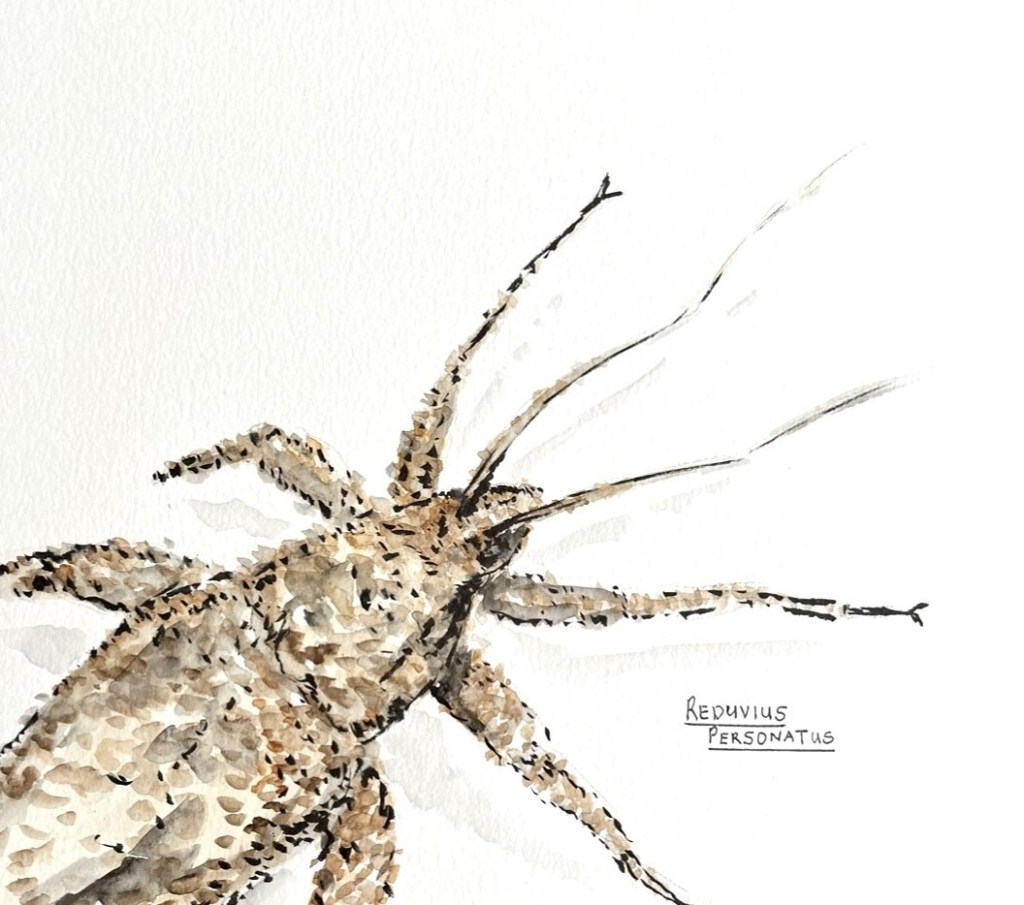
the dusty, mottled nymph of the masked hunter The masked hunter (Reduvius personatus) is a remarkable insect species for a few reasons, but mostly because the young (nymphs) camouflage themselves with bits of dust and other debris: often the detritus that tends to collect under your bed or bookshelf (they are found inside homes in many parts of the world). They look so very odd with their dusty, hairy, mottled, colouration and unusual “second skin”. The adults in contrast are more glossy smooth and black. Masked hunters are type of true bug, or Hemiptera and in the group known as assassin bugs. They are, as their namesake suggests, a predatory species, piecing and killing their prey with their piercing/sucking mouthparts. They hunt and feed on a suite of different critters, but are known to eat bedbugs, so this is good news! The less good news is that they can deliver a painful “bite” to humans and while not life-threatening, it sure can hurt. Weird and wonderful insects.
© Christopher M Buddle 2024
-
Under the Willow Tree
picnics with siblings
wet socks, mud, and apple slices
under the willow tree
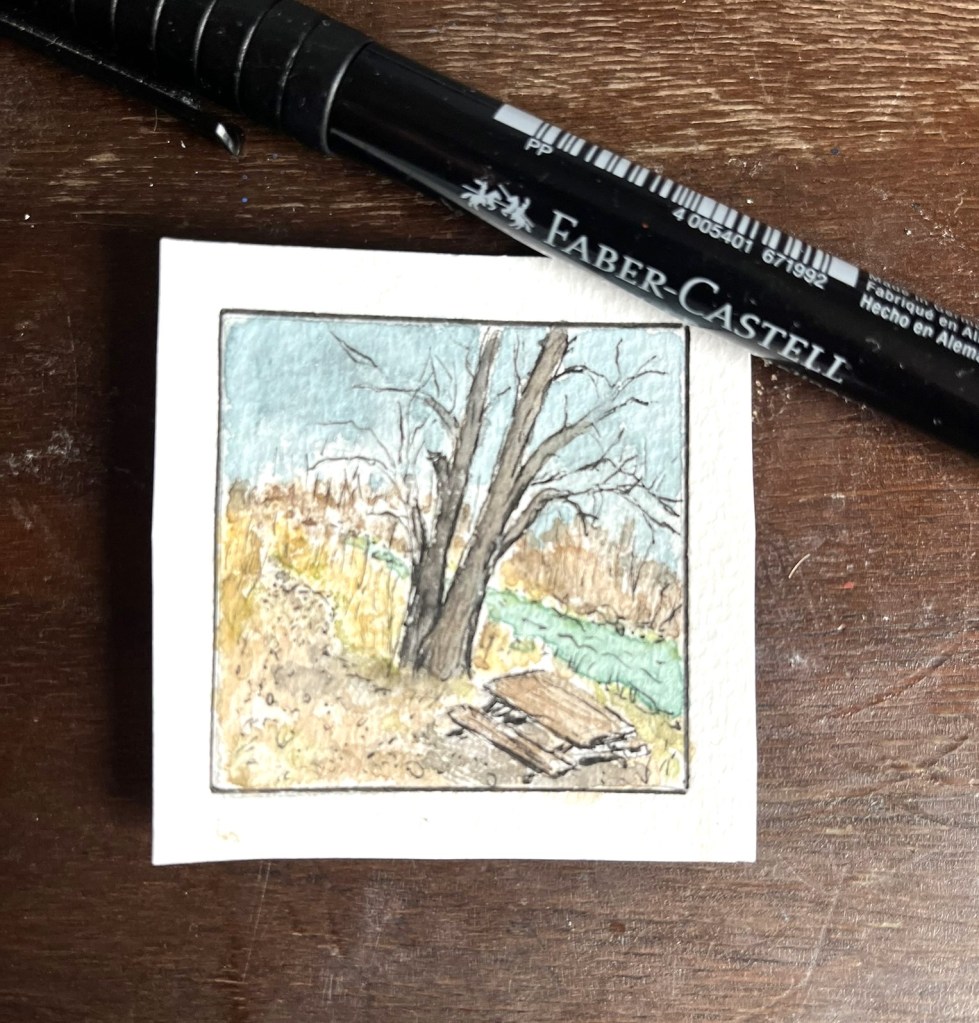
A thumbnail watercolour of the willow tree, picnic table, and babbling brook HAPPY NEW YEAR! I hope you are ready for a great year. There is a sense of optimism at the start of things, I find.
We spent a lot of time outside with our kids, from when they were very, very young. One of our favourite spots to walk and play was along a local path that meandered through forests and wetlands, and around a local creek. It was a hit for many reasons – the right length for a walk, lots of shade for hot summer days, and the babbling brook was the right size for little people. It was also a terrific place for collecting golf balls since upstream was a course and there were hundreds of balls that made their way downstream. All the local kids collected golf balls, and all the parents commented regularly about the bucket of old golf balls in the garage. Others learned to fish in the creek, and one local kid is now a fly fishing guide in Alberta: his life’s passion started near the willow tree.
We would take snacks and drinks, and the kids would climb the willow tree, get wet feet, and enjoy the freedom of outdoor play – play that was full of imagination as well as mud and sticks. We still walk the path regularly (with Quincy the dog since the kids are all adulting now!) and the willow tree and picnic table are still there, as if stuck in time. Sometimes we see young families playing under the tree, eating apple slices, getting soggy, and with smiles all around. It’s a timeless place, and it brings me so much joy to see it still being used.
Simple things are good things, especially when outside.
© Christopher M Buddle 2024
-
Hoppy Holidays
just imagine
mystical, magical, antlered beast
fact and fiction collide

Last week I mentioned “tricksters” in my post about Coyote, and this theme appears again today with the Jackalope, illustrated above. Earlier this year I read a terrific book about these mythical animals (which are sometimes labelled tricksters), and if you are curious, I recommend the read. You will learn about why antlered rabbits occurs in geographically distinct regions, and across centuries, the connection between jackalopes and cancer research, and why we are so enthralled with chimera.
The upcoming holiday season contains a lot of unusual, magical, or mystical symbols and traditions, whether decorated trees inside a house, reindeer flying, or the (terrifying) Krampus. Whatever floats your boat, I suppose.
Regardless of your views of the late-December holiday season, I hope it can at least provide you some time with your loved ones, and downtime in general. That is indeed my plan, and on that note, I may take a couple of weeks off from posting on the blog – I’ll see you in 2024!
Thanks to all who have followed along this year – so many new people have subscribed to Nature’s Reverie over the last year, and it is so appreciated.
Hoppy Holidays to you!
© Christopher M Buddle 2023
art, chimera, drawing, holiday, ink, jack rabbit, jackalope, mythical, nature, pen, rabbit, Watercolor, Watercolour -
Coyote
under moonlight
the trickster howls and yips
but will we ever listen?
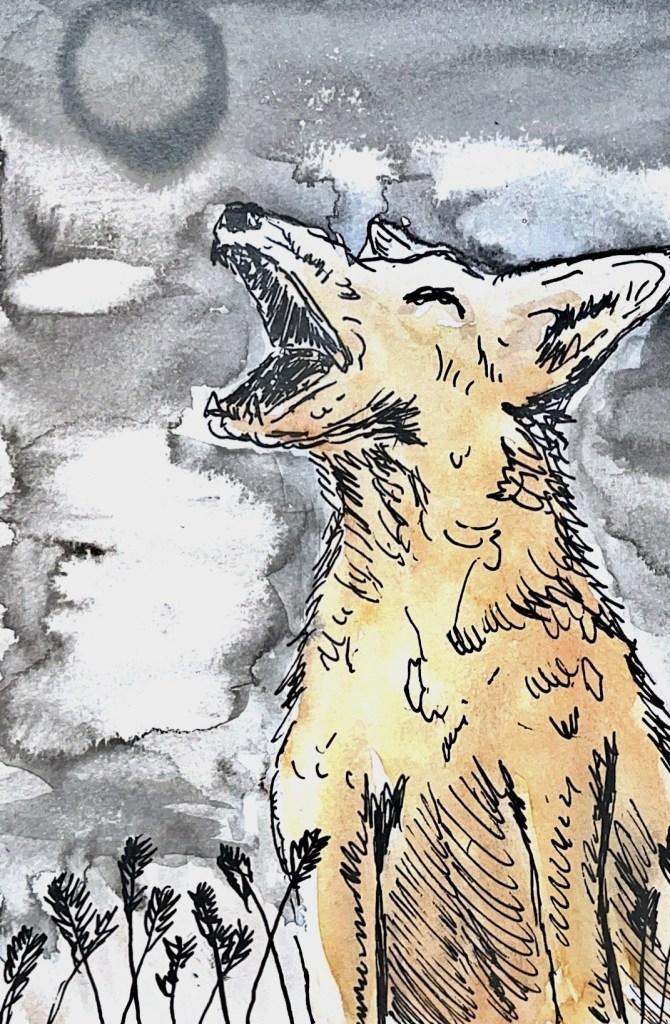
Notes: Coyote are common across so much of North America. They have a deep connection to humans, and are known as ‘tricksters’ by some Indigenous peoples. They are smart, adaptable, and survivors. They inhabit cities, towns, and roam through meadows and farmer’s fields. They are deeply hated by some due to their interests in snatching farm animals. They can be heard often at night, especially in rural areas, and have quite a diverse set of vocalizations. Their sounds can be spooky.
But like so many maligned species, they are deeply misunderstood. They are quite incredible animals, and they are just trying to survive. We need to listen to the natural world more often.
© Christopher M Buddle 2023
-
Bittersweet
at the dawn of December
across frozen fields
yelping dogs, chasing scents
frosty breath, rosy cheeks
under grey, angry clouds
snowflakes fall, stealing warmth
yet at the forest’s edge
the vine emerges
against the monochrome
dangling tiny tangerines
enchanting, delighting
and for a moment, sadness departs
nature’s gift of colour
during dark December days
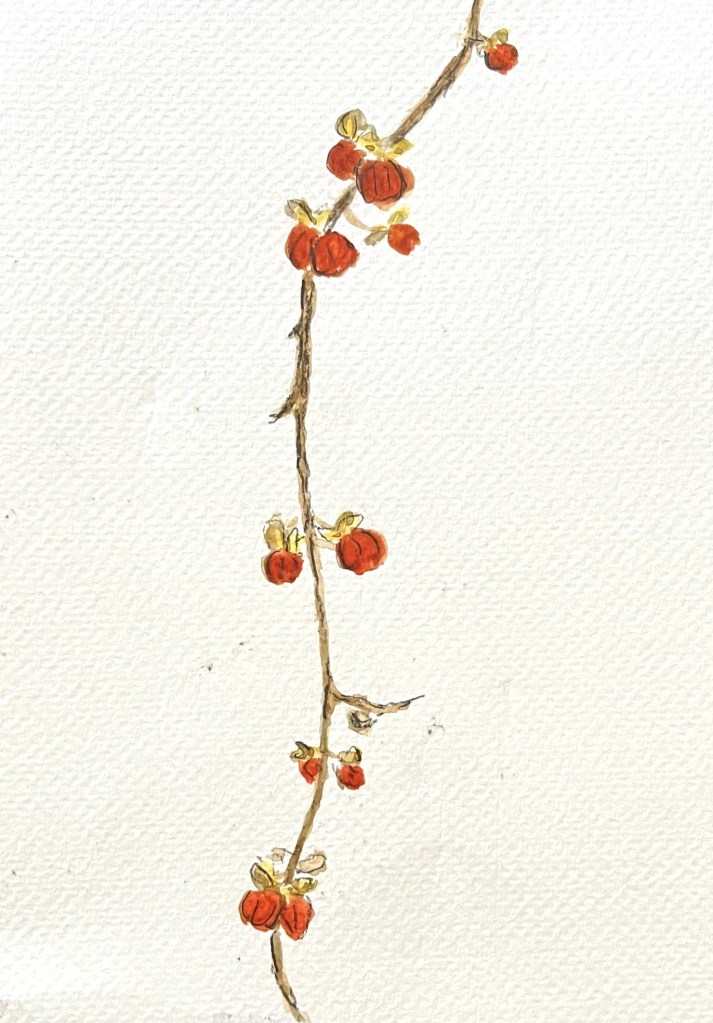
Bittersweet berries. Painted from memory, on a well-travelled scrap of watercolour paper. I would call this very unfinished, but I suppose finished enough. Notes: we have a new dog in our family so we have been embarking on many walks. One of the local meadows is lined with impressive hedgerows and within the brambles the bittersweet vines (both the invasive and native variety) are visible. They are easy to stop in late autumn since the leaves have all dropped so the orange/red fruits really pop (Although delightful to look at, they aren’t for eating!)
Bittersweet is an emotion that can resonate strongly this time of year; December can be beautiful but it also can have a touch of melancholy. Personally I am finding that my creative energy has waned significantly lately: it is a struggle to write and draw. But the joy of nature especially with the surprising brightness of the bittersweet berries is a respite.
© Christopher M Buddle 2023
-
Turkey (Tails)
a different kind of turkey
encircles its wooden host
autumnal colours emerge
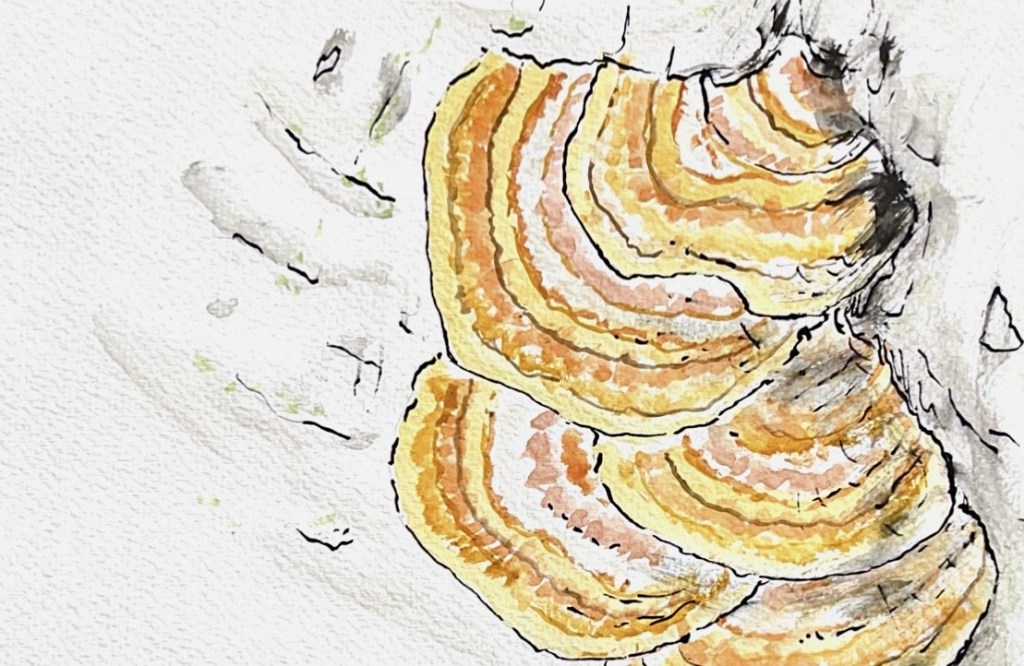
I’ve written before about ‘shelf fungi’ – a type of fungi that tend to grow, shelf-like, out of dead or diseased trees. This time of year is perfect for findings and appreciating polypores – their colours remain vibrant during the grey days of late Autumn. I thought it fitting to highlight Turkey Tails given that it was American thanksgiving last week. These are indeed a different kind of turkey, and not ones that would normally show up on the dining room table; although, in fairness, they are edible (although apparently better if ground down into a powder, perhaps for tea*)! The latin name for the species is Trametes versicolor, the latter meaning ‘various or variety of colours’. And while some of these fungi can be quite dark, many can have bands that are yellow-ish, light brown, ochre, or reddish. The species can be quite common in some forests, and always worth a moment or two of appreciation.
* I do not suggest eating ANY fungi without first ensuring its identity with an expert, a mycologist.
© Christopher M Buddle 2023
-
Woof
furry, fuzzy friend
the best day EVER (again)
always a good boy
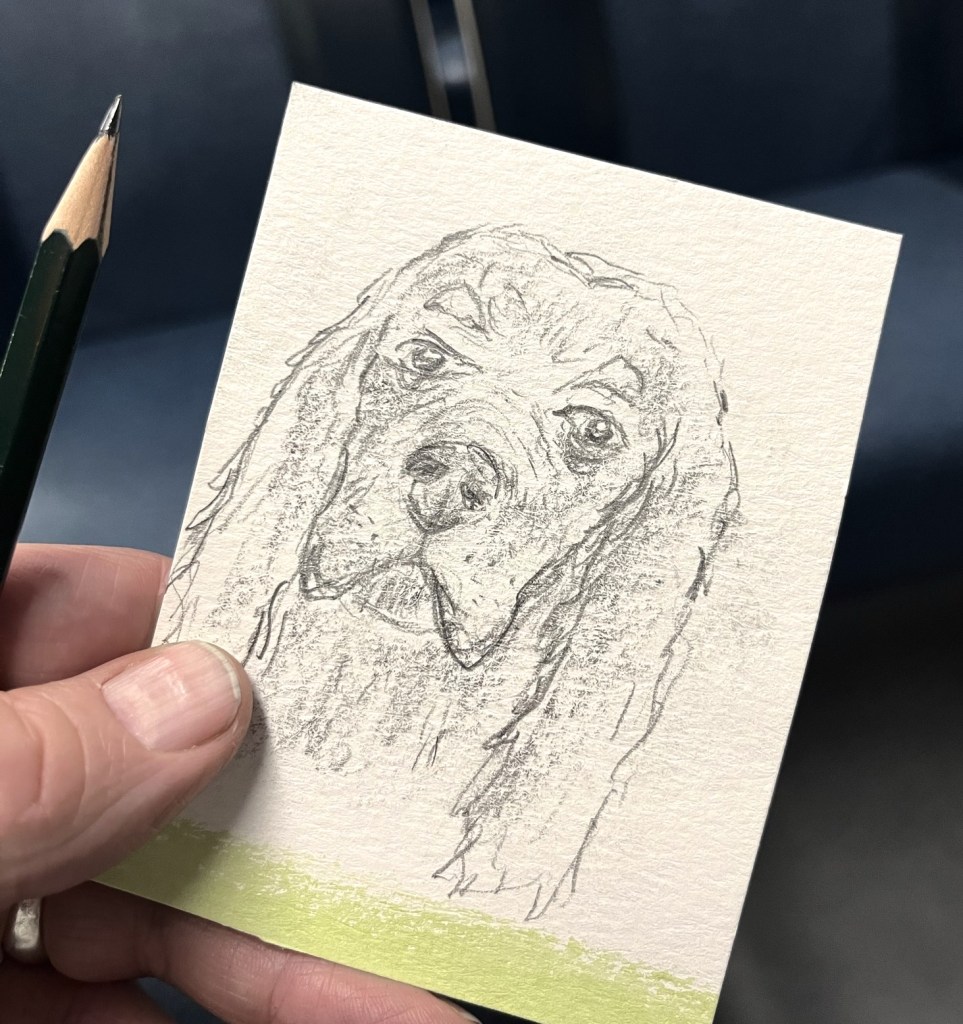
It’s been busy these days, so I only had time for a pencil sketch of Quincy, done on a scrap of watercolour paper found in my backpack. Just over a week ago we brought Quincy Cumber home. He’s a 7 month old American Cocker Spaniel. The breed is known to be friendly, and he has lived up to that reputation. He’s active, loves walks, and has amassed quite a collection of favourite blankets and toys already. What a joy. He only knows how to be a good boy.
One of the many things I love about dogs is that when they wake up in the morning, I think they say “IT’S THE BEST DAY EVER”. When it’s dinner time, “THIS IS THE BEST EVER”. When it is time for a walk, “THIS IS THE BEST WALK EVER”. And the next day, it happens again. Dogs make the world a better place. Woof.
 Nature's Reverie