The tiny musings found below will perhaps provide you an opportunity to pause and reflect on our world and our place in it. You can subscribe to receive posts in your inbox (approximately once a week)! Note: all writing and art is © Christopher Buddle.
-
first snow
gentle flakes fall
brighten a November day
snowy blanket

Last week we had our first real snowfall, with maybe about 5 cm accumulating in the early morning. November can be a dark and dreary month, but waking up to the snow changed the landscape entirely, and improved the spirits.
The first snow also catches the landscape a bit off guard, and the trees are often still adorned with a bit of greenery. Transitions are ever-present.
-
Falling
leaf senescence
hues of orange, yellow, red
fall towards winter
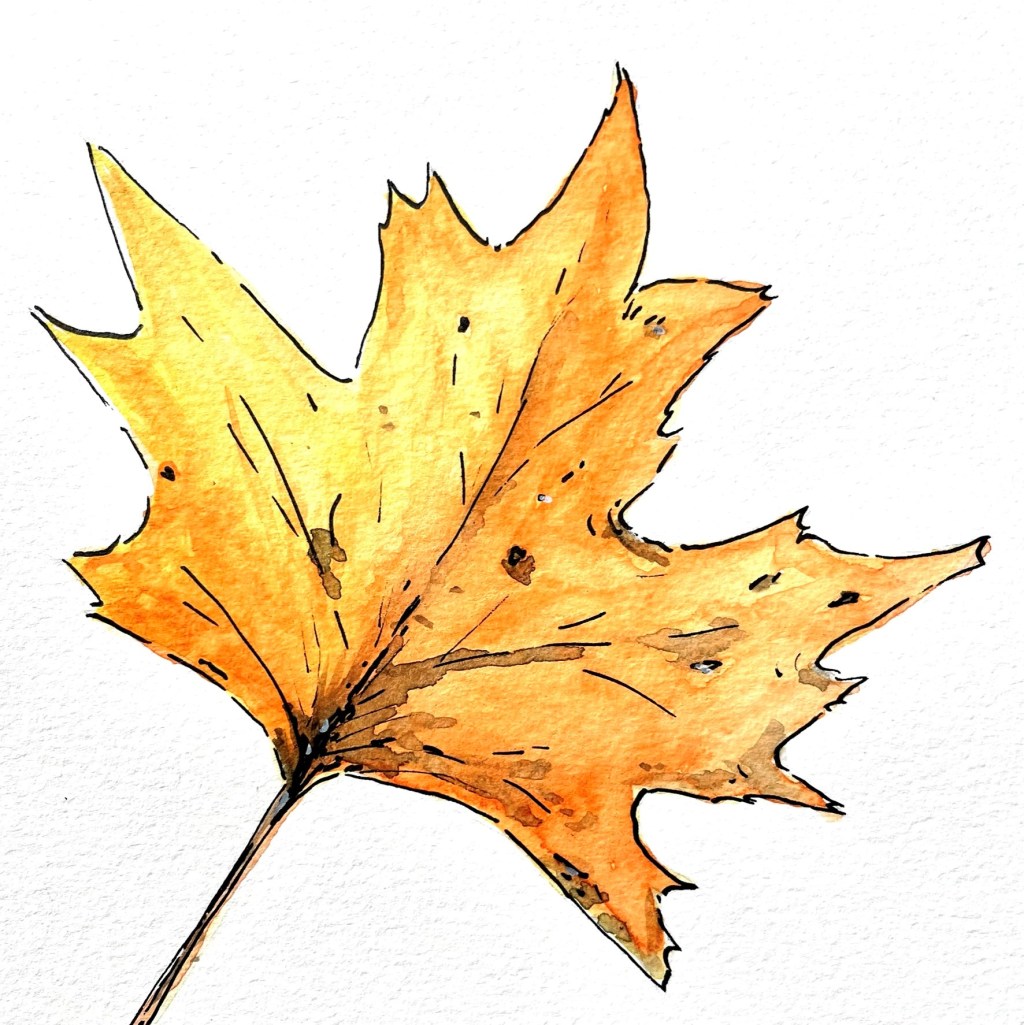
I adore seasonality, even as the autumn months lead to the dark days of winter. The fall colours are spectacular in my corner of the planet. This year was a bit unusual as we had a long warm September and October and only had our first frost last week. The leaves on our sugar maple didn’t start turning until very late, and then a windy day a week or so ago quickly cleared them from the tree. Time to make some big leaf piles and jump in, methinks.
art, autumn, color, colours, drawing, ink, nature, pen, senescence, Sugar maple, trees, Watercolor, Watercolour, yardwork -
Art for Conservation

Today’s post is some self-promotion and to also promote a local project I have been involved with for a couple of years. I was approached a while back to be a trustee for an emerging project to protect, in perpetuity, some wild lands near where I live. It’s been a wonderful experience, and I’m honoured to be involved. This area is called Creek 53, and all details can be found here: https://creek53.org/

While this Conservancy Trust has been constituted for a while now, we are doing our official public launch on 4 November, in a local pub in town. As part of this launch, we are also kick-starting some fundraising, which will include sales of 23 watercolours that I have created. These watercolours depict some of the flora and fauna of the Creek 53 watershed, and all proceeds from their sales will go back to the Trust, to further help the organization protect more lands. A few example pieces are shared today with this post – these are all framed and matted to 8×10″.

Art for conservation is, I think, a pretty great thing. And it gave me a great excuse to do more art!
© Christopher M Buddle 2023
-
the autumn jacket
frosty morning
embrace from an old friend
tattered autumn coat

A year or two ago my eldest son bought a used coat: a Barbour, which is a classic British waxed cotton jacket. I think they were originally hunting jackets, but now worn by many, and adored by many. They are expensive too, and high quality and made with care. Sourcing a used one, at a good price, is a nice find.
The jacket was too big for my son, so he ended up giving it to me towards the end of last winter. The coat was truly battered and tattered. It was well worn, some rips in the arms, but it was perfect.
It is heavy (in a comfortable way), smells great, and fits perfectly.
As the weather cools in this part of the world, pulling out the warmer clothes is a ritual, one that signals the changing of the seasons, the shorter days, and reflections about transitions.
The coat needed some repairs so I recently dropped it off at a vintage/thrift shop in Montreal- called mervmatsui. The owner is obsessed (in a good way) with Barbour jackets. He saw my love of the old tattered jacket and agreed to repair and re-wax it “let’s call it a project” he stated. I am getting the coat back this week and I can’t wait.
A favourite jacket is more than practical. This one reminds me of my son, the beauty of changing seasons, and an appreciation for well-made things, even if tattered.
-
wood duck
dabbling in wetlands
nature’s colours feed the soul
perfect waterfowl

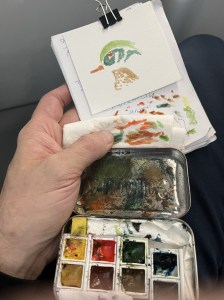
Wood Drake, thumbnail watercolour Wood drakes (i.e., the male wood duck) are spectacular – with colouration that is among the most incredible of all birds. They are dabbling ducks (feeding primarily off the surface of water), and also have the interesting natural history of nesting in tree cavities in forests, sometimes not proximate to the wetlands where they spend their time hanging out and eating. Their populations can be helped out by the installation of wood duck boxes. I was extremely busy last week, so doing any art seemed impossible, but I decided on Friday to toss my tiny watercolour travel kit into my backpack, and I found two squares of watercolour paper to bring along. I was thinking about wood ducks (you will understand why, if you read all the way through this post) so decided to try drawing them in miniature form, and the piece above is one of the results. The process, while on my commuter train, looked like this:
This blog is about the uplifting, amazing, and awe-inspiring ways of nature – whether small trees growing out of sidewalks, snapping turtles, pigeons, or the glorious wood drakes.
Life is difficult for many right now – wars, tragedies, climate change, and everything in between. It’s downright awful and at times like these it can sometimes be difficult to see or appreciate beauty,
I get it.
At the same time, nature can help us heal, or give us pause from the awful; maybe even just for a minute as you walk through a park or glance up at a passing flock of geese. It can give some comfort in difficult times, perhaps.
I was reflecting on this very topic one day last week when I read my weekly newsletter from James Clear (it’s one of the few I subscribe to and read regularly) and in it he posted from The Peace of Wild Things by Wendell Berry, and it’s worth reproducing here:
“When despair for the world grows in me and I wake in the night at the least sound in fear of what my life and my children’s lives may be, I go and lie down where the wood drake rests in his beauty on the water, and the great heron feeds I come into the peace of wild things who do not tax their lives with forethought of grief. I come into the presence of still water. And I feel above me the day-blind stars waiting with their light. For a time I rest in the grace of the world, and am free.”
Stay well.
-
end of the line
a town connected
fresh air welcomes commuters
autumn colours

I live in a small town, and it’s at the end of the commuter train line. It’s a quiet, lovely village with lots of character, strong sense of community, and isolated enough from the city that it feels special. It’s a country place, surrounded by agricultural fields and forests. Each morning I hop on the train with a group of commuters and school kids and we travel just over an hour into the heart of a large city. At the end of the day we return, tired, weary. But stepping off the train and breathing in the fresh air reminds us all why we love to live in the town. It’s especially nice this time of year with the fall foliage – bathing the world in reds, oranges, and yellows.
Being at the end of the train line is a good place to be.
Note: I realize this post is coming out on a Tuesday – oh my! Yesterday was a holiday here in Canada, our thanksgiving long weekend. So, you get this post today instead.
-
Autumn flowers
stand tall, sway
golden autumn gardens
petal power

Rudbeckia – known commonly as black-eyed susans- are perennial flowers common in gardens. We have a lot of these growing at the border of our back gardens and next to the house. In the late summer their delightful yellow petals bring perfect hues to our world, and they bloom for such a long time and insect pollinators are often found on the flowers. Their seeds are adored by birds too, so it’s a plant that sure gives a lot. They seem to grow tall at our place, getting above their neighbors and swaying in the wind.
I read over on Wikipedia that the genus name (Rudbeckia) was given by Linnaeus in the early 18th Century in honour of Rudbeck the Younger – a supporter and fellow botanist, and Rudbeck’s father, Rudbeck the Older (of course). The Older founded Sweden’s first botanical garden.
Linnaeus’s dedication to Rudbeck is lovely:
“So long as the earth shall survive and as each spring shall see it covered with flowers, the Rudbeckia will preserve your glorious name”
The natural history of a species provides us stories for the ages.
The watercolour depicted above is again a tiny one, done in a wee little watercolour album. Not sure why, but I seem to like making small art.
-
Rats
sniff, scurry; friend, foe?
cunning, crafty stowaway
you are everywhere.
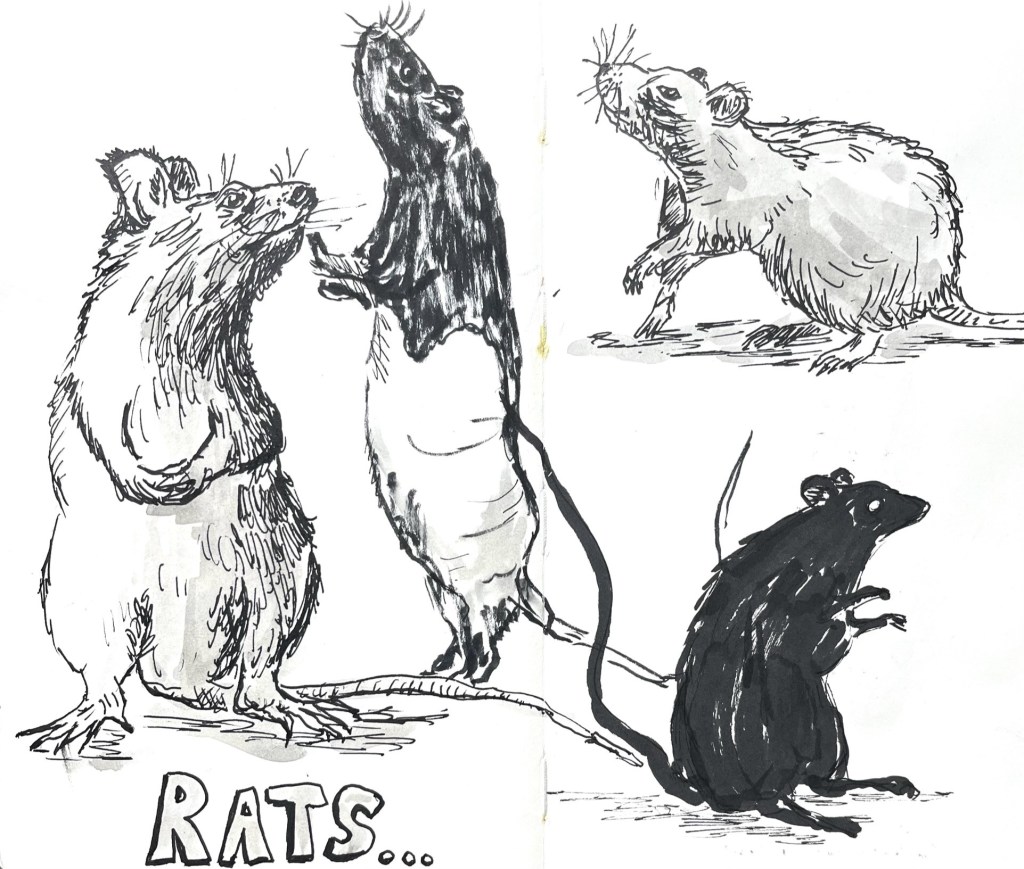
Rats are hugely misunderstood. I was reminded this when I read a piece recently in The New Yorker, originally published back in 1944. They are implicates in carrying diseases of various kinds, they infest cities causing many problems; they lurk in the dark, and are almost impossible to eradicate. They have travelled around the world in the holds of boats, invaded islands and destroying populations of native species. They are everywhere; some species of rats are truly cosmopolitan.
But they are also highly intelligent, and have been used in scientific research which has in turn supported significant medical breakthroughs. I think they are beautiful too. I had pet rats when I was a kid – I remember fondly Ralph, and Ralph II. They were wonderful friends, and I sure cried when they developed tumours and died. Like to many species in the world, sometimes a bit of knowledge helps us understand things better, and allows us to be more nuanced in opinions. So, why not grab a sketchbook* and draw some images of rats, snakes, spiders, or sharks. Appreciation can grow from art, I find.
*the illustrations above were done in a Moleskine sketchbook from reference photos, and with a technical pen or brush pen and the shading was done with a water brush (filled with water and just a few drops of ink).
-
Bridges
through the twin cities
the mighty Mississippi
connecting, flowing
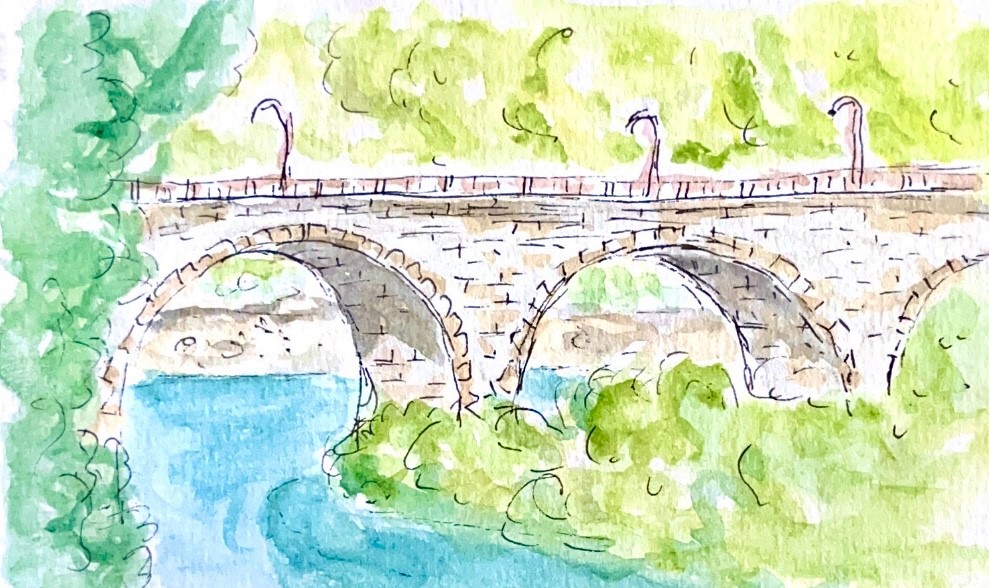
Stone Arch Bridge, Minneapolis Last week I visited Minneapolis for a work trip. I thoroughly enjoyed it, especially walking along the banks of the Mississippi. The bridges across that river are wonderful, whether the Stone Arch bridge illustrated* above, or the Hennepin Ave bridge, illustrated below. I ate at great restaurants, watched the Twins play baseball (twice), and appreciated the pace of the city.
It’s a fine spot, thank you Minnesota.
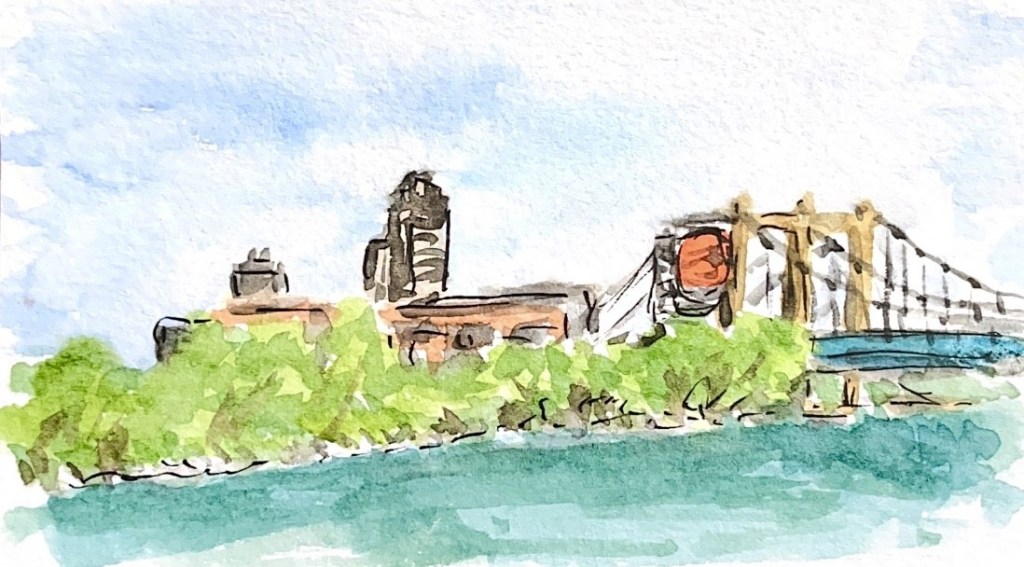
Hennepin Ave Bridge, Minneapolis * the two watercolours were done during my trip, on very small (maybe 3×2”) scraps of watercolour paper that I had shoved in my backpack along with my brush pen and a travel watercolour pan. Sometimes small is nice, even if the bridges and the Mississippi river are grand.
P.S. I prefer bridges to fences.
-
Field birds
mosquito hunters
dashing, darting over fields
bicoloured beauties
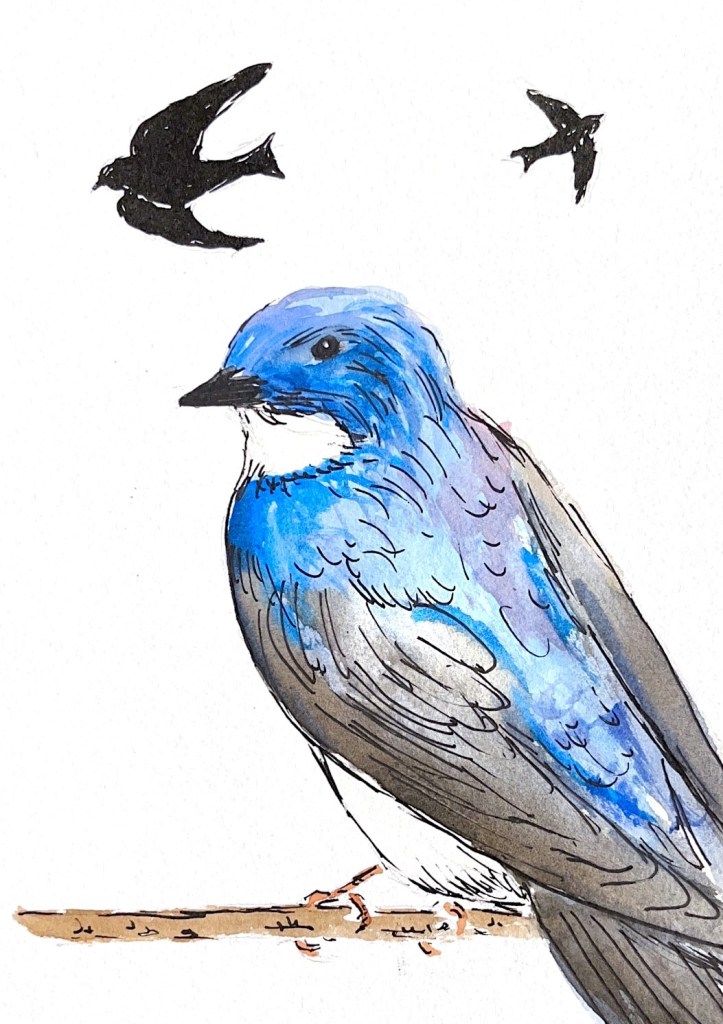
Tree swallows are fun to watch – aerial acrobats, feasting on insects including mosquitoes. They are extremely attractive birds, with iridescent blue on their back, almost shimmering, with white underside. This is reflected in their Latin name Tachycineta bicolor – the latter part reflecting their two-coloured pattern. They are widespread, found (in the summer) across much of Canada and the USA, and spending winters in Mexico and Central America. They nest in tree cavities naturally, but also in boxes constructed to provide more nesting sites.
On another note, over 50 posts have been published on Nature’s Reverie! The one year anniversary of this site was passed last week. It has been a pleasure to bring you these short pieces each week, and THANK YOU for your support. Please share, and continue to follow! And don’t hesitate to give me any feedback you have.
 Nature's Reverie