The tiny musings found below will perhaps provide you an opportunity to pause and reflect on our world and our place in it. You can subscribe to receive posts in your inbox (approximately once a week)! Note: all writing and art is © Christopher Buddle.
-
books
magic on a page
small stories, grand adventures
never-ending gift
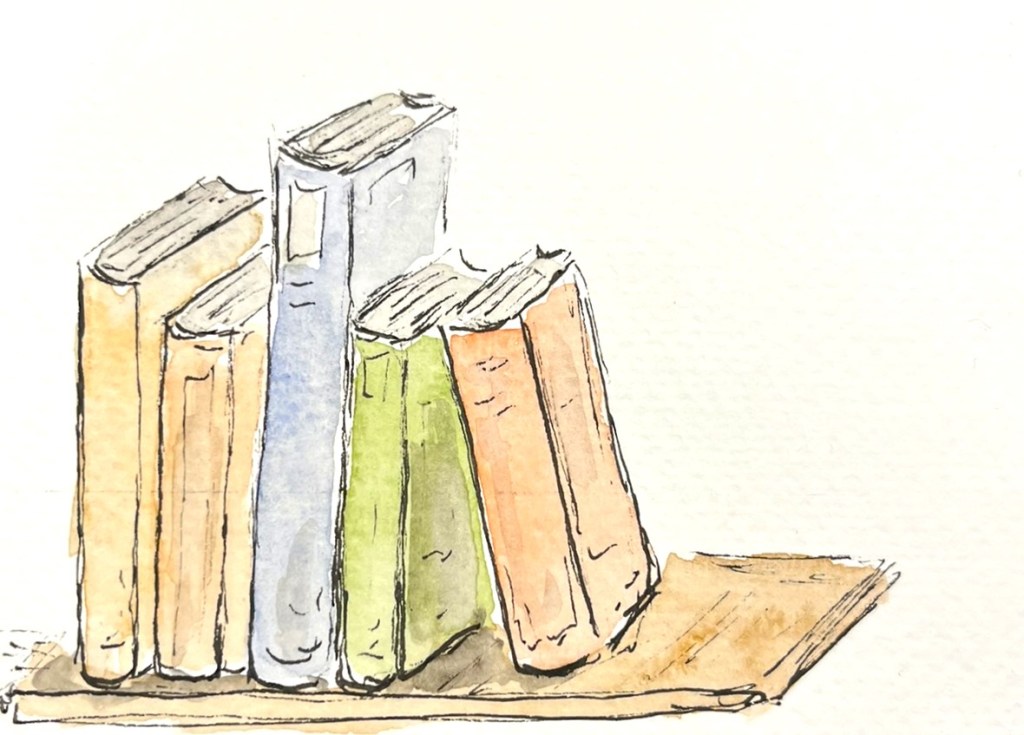
Books.
Reading.
I love reading. I love books. I’m a pretty avid reader, daily – often finding a bit of time on my commute, and I always read before falling asleep each night. For me, the written word is one of the greatest gifts in the world. Part of the upcoming holiday season is a celebration of books, and usually there are more than a few books under the Christmas tree.
But I am curious about how many of you share this perspective: I accumulate long lists of books I want to read ‘sometime in the future‘, and the pile on my bedside table grows faster than the rate at which I read. While I still have decades ahead of me, there are more decades behind me, now. I sometimes look at all these book titles and worry that I will not get a chance to read everything on the list. Actually, to correct that statement: I will *not* read everything I want to read to before I die. This is irrational, but it is something that comes to my mind on a semi-regular basis. It’s like the thought of missing great writing is a reminder of my finite lifespan. One might wonder why I do not think of this signal of mortality in terms of kids growing up, perhaps grandkids in the future, future friendships, adventures and so much more. Life has a limit, and there is only so much one can do with the time we are given.
Perhaps it is simply that books are the very regular reminder of this.
I suppose one way to address this, directly, is to be far more discriminating in what I read. I could be more selective, and only pick writing that is perfect in its prose, or top of the New York Times lists, or only things that are highly recommended by my bookish friends.
But I can’t.
I just can’t.
I just love to pick up new (or used) books, and at the time, I think “oh I can’t wait to read this, I’ll get to it soon“. I savor reading, and each day look forward to time with a book. It can be detective novels, fantasy, nature-themed non-fiction, thought provoking books, literature from the past, poetry, graphic novels, and on and on.
How to you come to terms with the ever-expanding list of books to read?
© Christopher M Buddle 2024
art, Books, drawing, ink, life, Literature, mortality, pen, poetry, reading, Watercolor, Watercolour -
nesting
perched perfectly
a crafted basket called home
fragile and strong
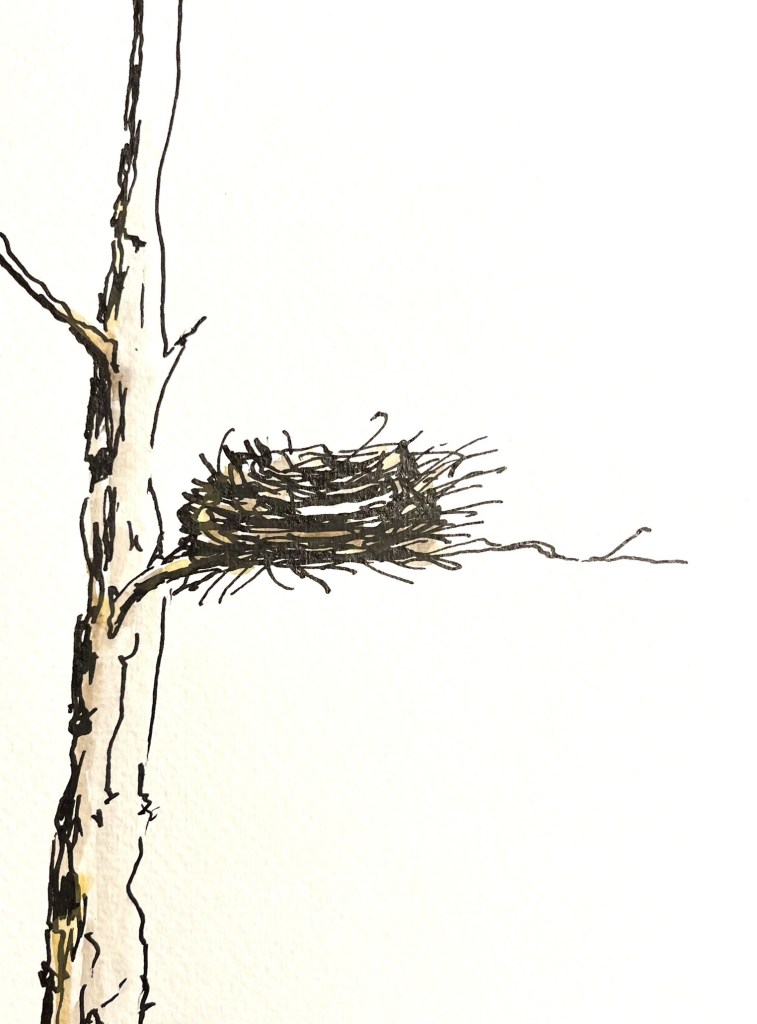
Sometimes natural history observations are about seeing the evidence and echoes of life, rather than seeing a species in action. Abandoned bird nests – easily seen when the leaves have fallen, during the autumn and winter – are examples of this. These nests sit empty now but it’s comforting to know they once housed perfect tiny eggs, and hopefully some of those eggs hatched and stayed safe and eventually the baby birds fledged.
And, of course, we often think of nesting as we enter the colder season (here in the northern hemisphere anyway!).
Happy Nesting to all.
© Christopher M Buddle 2024
-
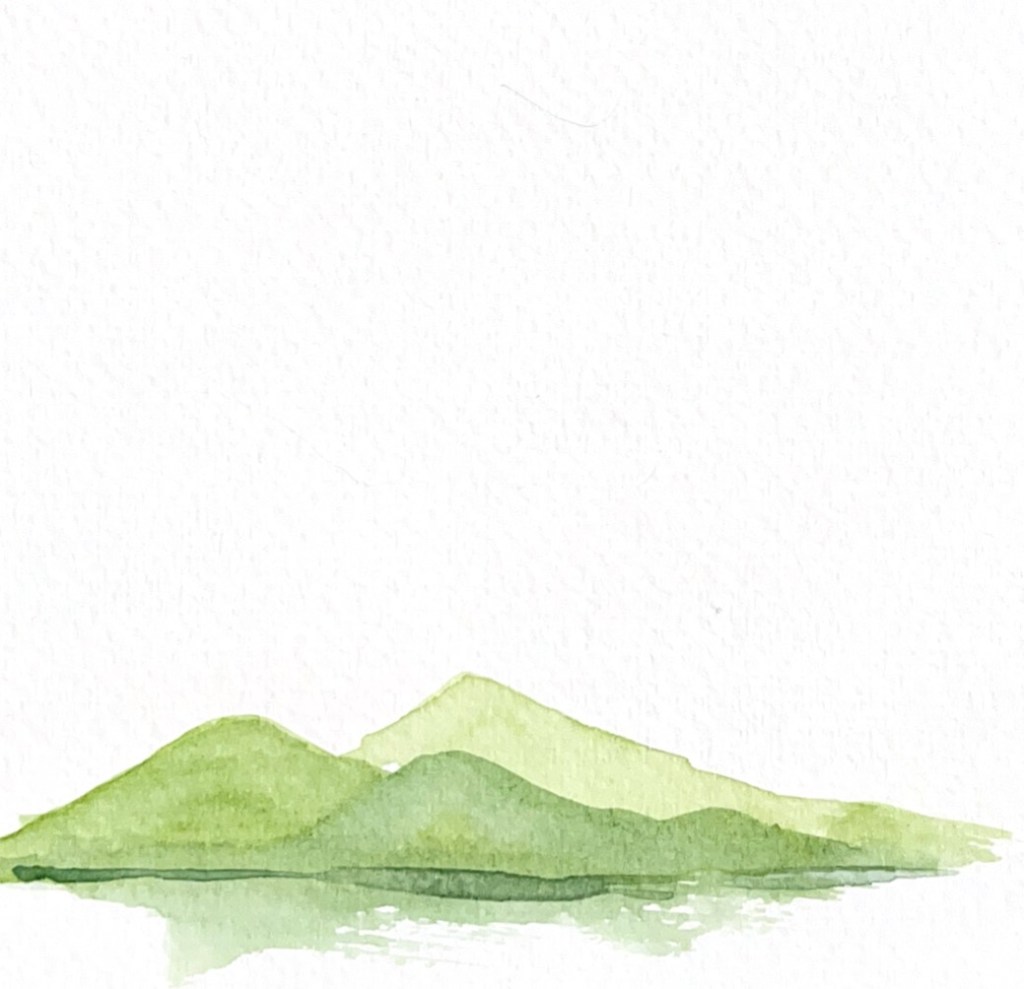
mountains
the deeper I go
the deeper I go
green mountains
– by Santoka Taneda (1926)
That Haiku is one of my most favourite. It has been rumbling around my head for weeks, months or longer. I’m not exaggerating when I say that it comes to the front of my thoughts many times each day. It’s as close to perfect as you can get, in my view.
The above Haiku was written by Santoka Taneda almost one hundred years ago (by the way, I think this is the first time I put a Haiku on Nature’s Reverie that I did not write myself). He was famous for many of his Haiku, notably writing ‘free verse’ and he lived an extremely difficult and tragic life. A few years ago I bought a book of his works (called All My Walking) and the translations were done by Burton Watson. There are other translations available, including this one:
going deeper
and still deeper
green mountains
And while I like that one, I think I prefer Burton Watson’s take. I’m not really sure why but I think the same repeated first line just works so beautifully.
Why do I love it so much?
I see it as being lost in your thoughts, you mind, perhaps dark places, perhaps whirlwinds of emotions. You go deeper. And deeper. It’s a whirlwind and endless storm that you cannot escape from. Perhaps waking in the middle of the night and working through your thoughts and ideas and emotions and love and pain and hurt and confusion and perhaps joy, too. And as you think and reflect and ponder you go deeper, and deeper. And when you travel – literally or figuratively – the journey takes you deeper, further, and along that well worn path, that never-ending road. It takes you deeper, and deeper, and deeper.
And then suddenly, there, in front of you is a gift.
The green mountains. Lush, rich, verdant. Strong, solid, in place, rooted, firm, and magnificent. The end of your journey, or perhaps the beginning of a new one. A destination, but one that is peaceful and caring. Above the horizon, reaching up and stretching out with that perfect angle of repose on each side. With a peak, beckoning and calling your name. Grounding you. Anchoring you.
Nature, and those mountains, pull you from your inner depths. The mountains grab you, offer perspective, and their bigness reminds you in the best possible way of your smallness. You can walk beneath that mountain and not bother it. Its presence calms you. The green mountains are perfect.
What does it mean to you?
© Christopher M Buddle 2024
-
schools
somewhere in the sea
swimming in all directions
class is always in
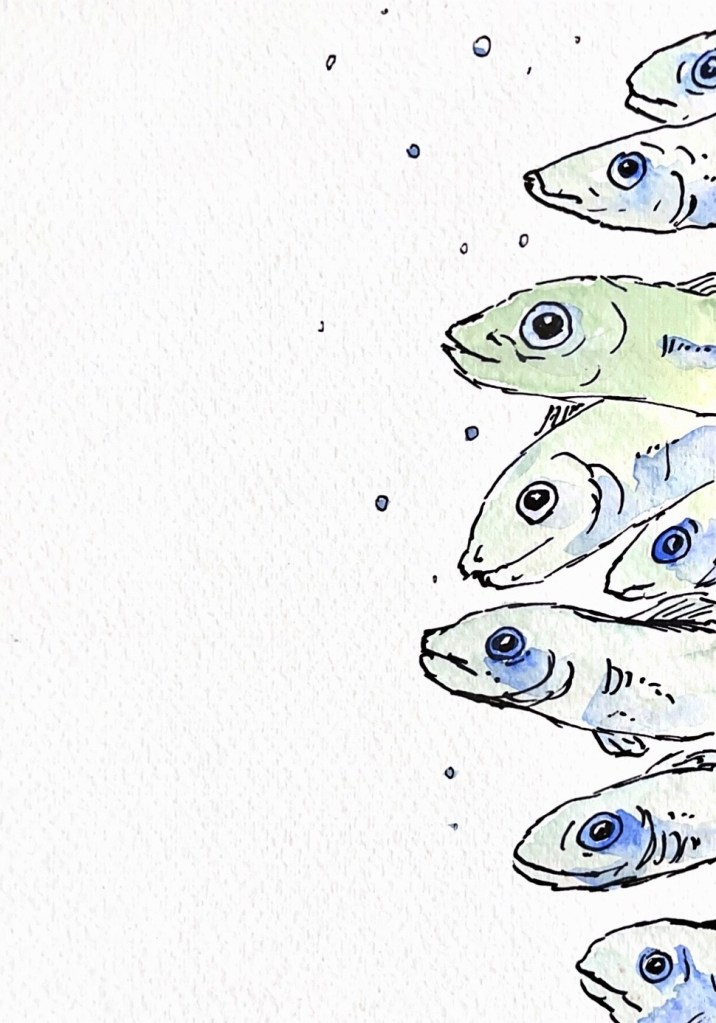
Sometimes as I trudge about in this terrestrial world I pause an imagine the vast oceans, and the aquatic creatures therein. They live in a mysterious world – one of high pressure, darkness, and ever-present threats and opportunities. I can understand why so many fish do school together. Strength in numbers sounds important in such an imposing environment.
Go, fish, Go.
UPDATE:
An old friend of mine (who is now a retired geography teacher) sent me a Haiku inspired by the one above. I love it and wanted to share here;
somewhere in the past
swimming in ALL directions
was my Geography class
© Christopher M Buddle 2024
art, drawing, ecology, Fish, ink, nature, pen, poetry, school, sea, underwater, Watercolor, Watercolour -
by a thread
a single silk thread
gently sway with autumn’s breeze
survive, thrive
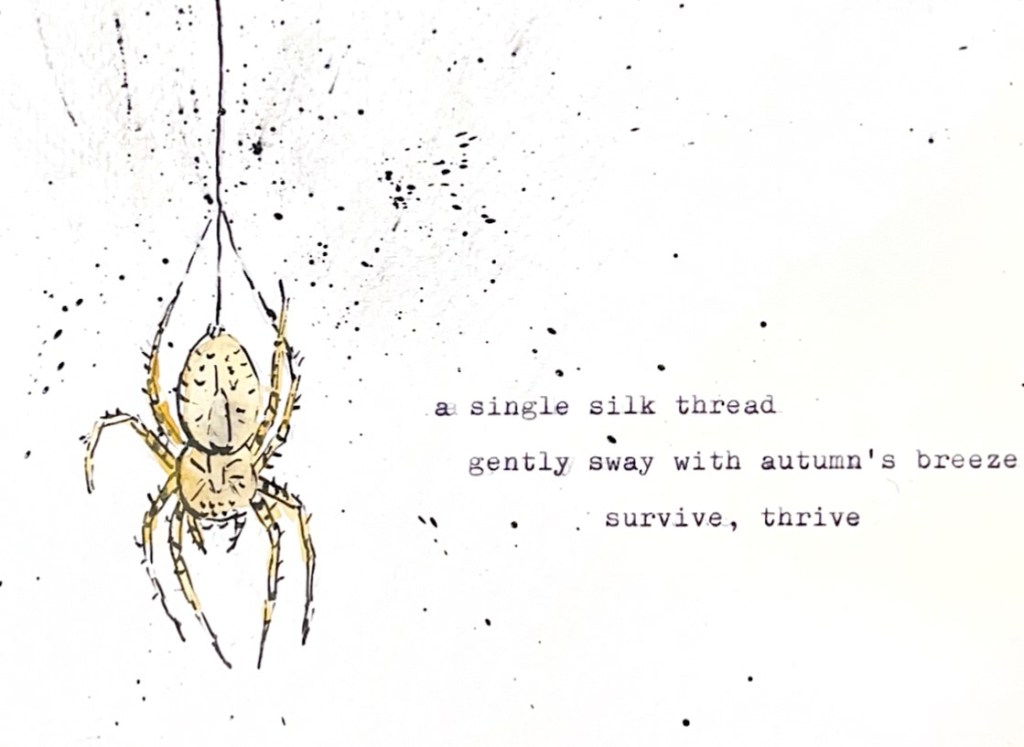
I do love seeing spiders this time of year, although it is with a touch of sadness since their lives are winding down. However, many of the web-building species do mate in late summer or autumn and their egg-sacs overwinter, hatching in the spring and starting the cycle again.
I also find the resilience of spiders something to admire. If you handle spiders (which I often do*) and they happen to jump off your hand or arm, they will release a drag-line. This silk strand catches them as they fall and they often keep releasing silk as they fall so when they get to the ground, it’s a gentle landing.
While many people dislike spiders, I do encourage you to take pause and admire them (or their handiwork). They are remarkable animals.
*spider bites are exceedingly rare. So while there are many stories of bites out there, it’s very unlikely you will be bitten by a spider.
© Christopher M Buddle 2024
-
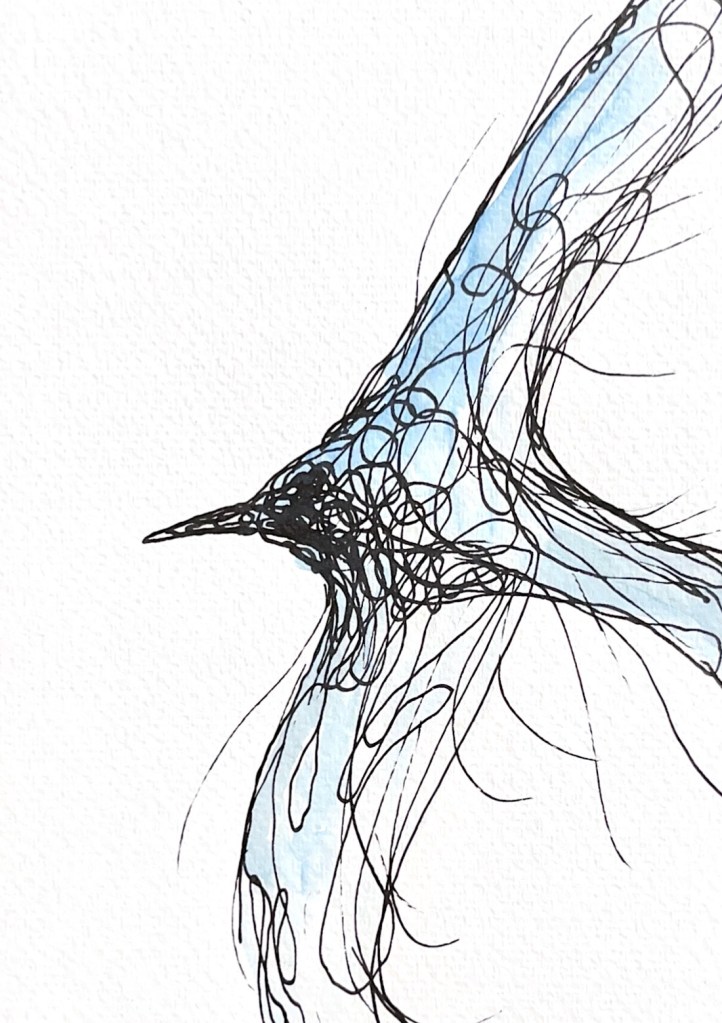
soaring
gales, gusts, thermals
tracking the patchwork below
avian dreams
© Christopher M Buddle 2024
art, bird, Birds, drawing, flying, ink, Landscape, nature, ornithology, pen, poetry, Watercolor, Watercolour -
the barn
forgotten barn
holds memories of back-breaking work
spirits from afar

Many traditional barns have been replaced by large, modern structures, but the old ones still stand and tell their own stories. They speak to us from their quiet corners on seldom travelled country roads. Shrubs have grown up around the faded wood, and on a windy day you just might hear the weathered slats rattling. I am not really a believer of ghosts, but at the same time, if you asked me to sit quietly in an old barn, on my own, I think I would hear things and sense things that are not of this world. But these old buildings are beautiful in their own right, standing proud, acting as landing spots for birds and safe harbour for wild creatures.
© Christopher M Buddle 2024
-
morning song
the meadowlark
morning-song across the fields
my steps seem lighter
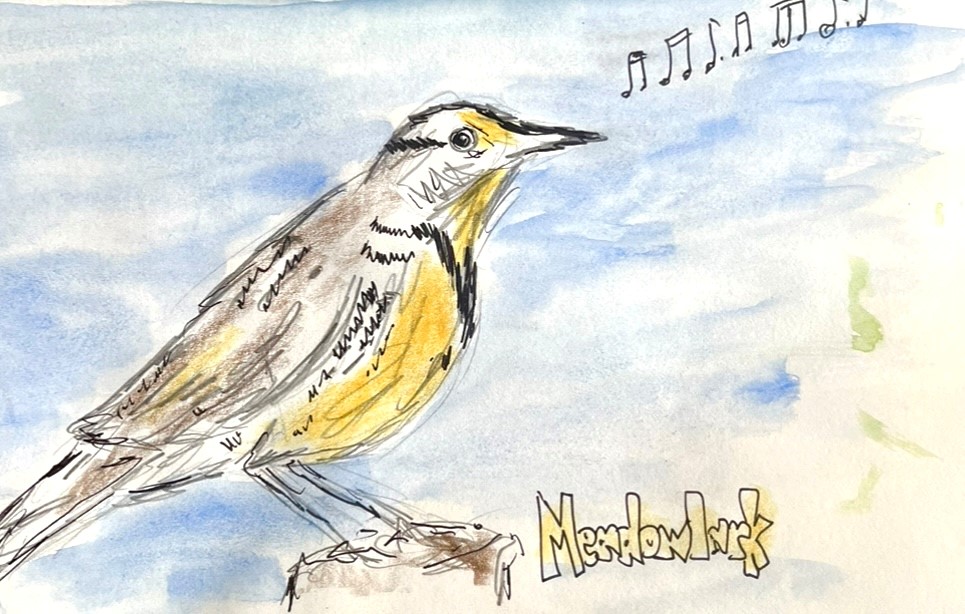
Meadowlarks are simply amazing birds – the males have incredible colouration, but what I most adore is their song. In my part of the world, Eastern Meadowlarks are sometimes seen, but much rarer of late, and they are a declining species in general, across their range. Their habitats are open fields, and grasslands and prairies, and these habitats are in decline. They also occur in agricultural fields, but farm practices can damage their populations.
I had a weekend getaway recently and was on a property in the country, with plenty of farm fields nearby. When walking the dog early one morning, to my delight I heard and saw Eastern Meadowlarks. Indeed, I was buoyed by this experience. I quickly pulled out a set of odd-ball art supplies I had at the place we rented, and the image above is a quick rendition of the bird, with a mix of pencil, pencil crayon, ink, and watercolour.
Grab your sketchbook! Keep your eyes and ears open!
Nature awaits.
© Christopher M Buddle 2024
-
adrift
warm October sun
feathered seeds, adrift
an autumn escape
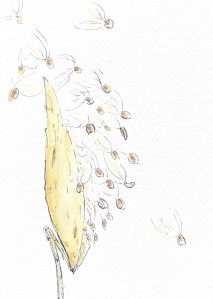
Milkweed pods with their seeds emerging are a strong symbol of autumn. Walking through fields in October, seeing the seeds in flight, with their long plumes, is just lovely. They are a reminder of the season that has passed, but also the seasons ahead.
Seeds contain potential and hope.
© Christopher M Buddle 2024
-
from the shadowed forest floor
shadowed forest
escape the drab detritus
magic, tiny world
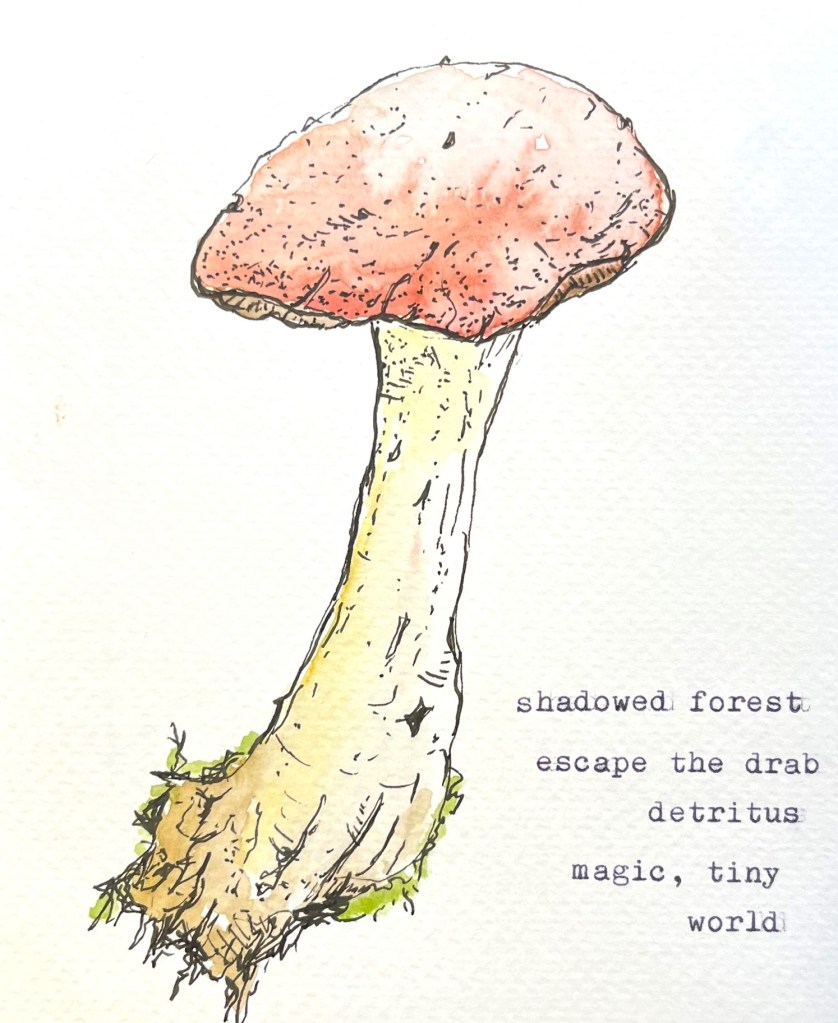
It’s mushroom season! (but not for much longer, as the frosts and cooler weather is starting now).
Mushrooms are splendid – and while they appear throughout the year, they are especially prevalent in the autumn months, poking up from the forest floor. A joy to see, a joy to pick (for mycologists who know the right species for eating).
Revel in their splendor!
© Christopher M Buddle 2024
 Nature's Reverie