The tiny musings found below will perhaps provide you an opportunity to pause and reflect on our world and our place in it. You can subscribe to receive posts in your inbox (approximately once a week)! Note: all writing and art is © Christopher Buddle.
-
January
Cough, hack, phlegm, mucous
a soup of viruses
welcomes the New Year
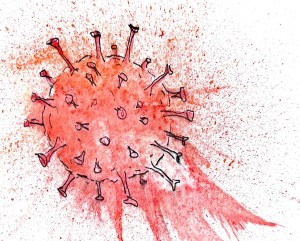
Notes: There are certainly quite a lot of viruses making their way around our society right now (especially in northern realms). Whether COVID, RSV, influenza, or other unknown colds, there are many people feeling unwell as we begin 2023. Our own house was certainly not spared – many of us had COVID* back in the late autumn, but some other ‘bugs’ were in the mix over the holidays and into the new year. Things are looking up the upswing now (for us!) but if you are still feeling unwell – I hope you can rest up, heal, and feel like yourself again soon.
*It is fortunate that my immediate family all had relatively mild cases of COVID, but I know it’s a very serious illness for many people – my good friend Eleanor has written about her experiences – it’s worth a read.
-
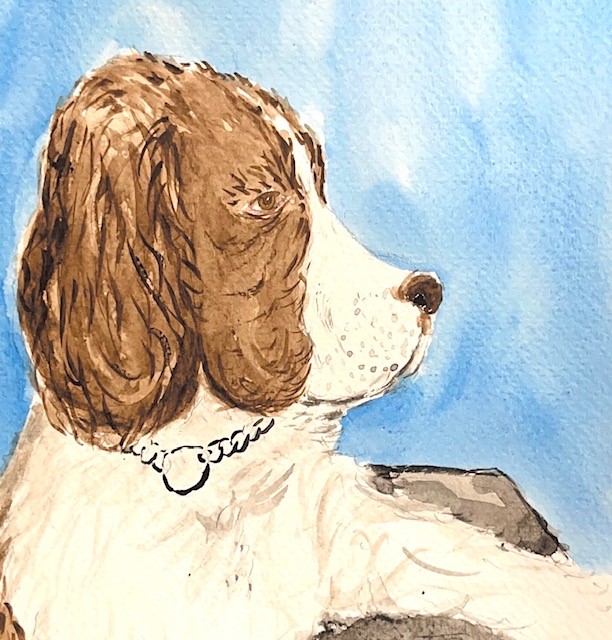
Max
Springing through underbrush.
– with smiles on our faces.
Forest bathing.
Notes: First and foremost – Happy New Year! I’m excited to keep bringing you posts every week (hopefully!). Please share with others, – perhaps you know people who would enjoy receiving these mini art and poetry posts each Monday.
We had the pleasure of dog-sitting for part of the holiday break – a two-year old English Springer Spaniel named Max. He was a wonderful house guest – full of energy, but a pooch who was also able to chill. There were many highlights, but top among them was surely the long walks through local forests, and watching him bounce through the snow. He loves to run, and if dogs could smile and tell you stories, I know Max would say that his happy place involves dashes through the forest. There is great evidence being in nature is beneficial for overall wellness – a term sometimes known as forest bathing. Dogs have this figured out.
© Christopher M Buddle 2023
-
The Forest Path
On a winter foot-path
silhouettes emerge
– reaching skyward

Notes: Over the holidays we had many consecutive days of cloudy skies, but even the grey days bring interesting sights, especially when walking along some of the many forest paths near my house. I snapped a photo of tree silhouettes as we were returning from a jaunt with Max (the beautiful dog we hosted for ten days or so). For some reason that view of the trees at the end of the snowy path stuck with me, and one evening last week I took out a wee square of watercolour paper and tried to capture it from memory, and that’s the illustration, above. The original is about 2 x 3 inches in size. Small is sometimes fun, even when the subject matter is large!
© Christopher M Buddle 2023
art, drawing, ink, Landscape, nature, pen, silhouette, snow, thumbnail, Watercolor, Watercolour, winter -
Tannenbaum
Family, food, and rest.
Baubles nestled within boughs.
Traditions run strong.

Happy holidays!
The tradition of putting up an evergreen tree inside a house, adorned with twinkle lights, baubles, and homemade decorations, is, well, weird and wonderful. There are countless other traditions that people follow at this time of year, and I know that they bring a lot of joy. At the same time, the holiday season can be difficult for some, so we can’t forget the dichotomy of this time of year. For me, I am looking forward to some downtime, time with family, good food, and rest. I hope to read a few books, do some long walks, and avoid screens to the extent possible. And on that front, I will not be posting again until January. I also extend a big THANK YOU for following this blog over the past few months. Your interest and engagement is so uplifting – I am grateful.
© Christopher M Buddle 2022
-
Caw, caw
Caw-caw: watch, hop, flap
– black feathered harbinger
you see right through me
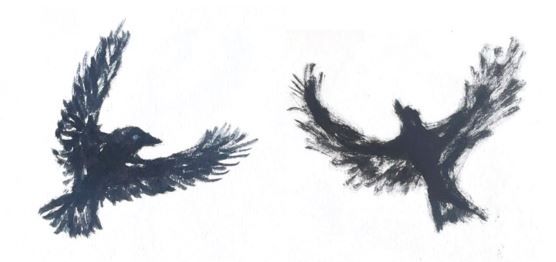
The lone crow cries
across the frozen field.
Civic twilight
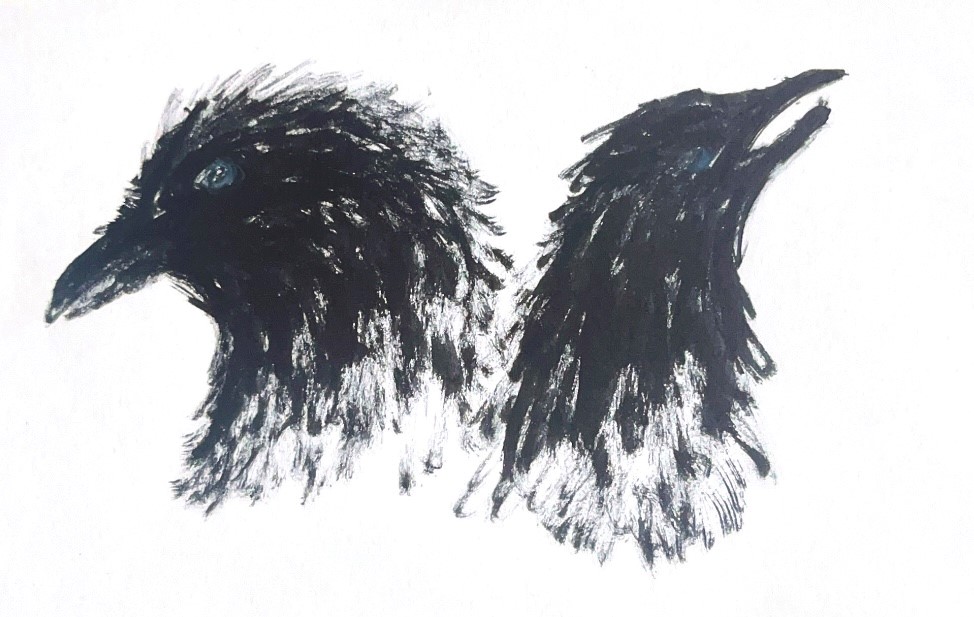
Notes: I am in awe of crows* and enjoy drawing them**. There are great books written about crows (and their relatives!), that highlight their intelligence, behaviours, and inquisitive nature (some good videos out there too). I like to watch crows, especially murders*** of them, bobbing their heads, hopping about, talking to each other. I am grateful that I see and hear crows almost daily.
It is a dark time here in Montreal, in early December. And when in a mood reflective of the short days I am reminded that crows are also symbols of darkness, and can be frightening, or remind us of bleak or desolate or difficult times or places; they can be harbingers of more darkness ahead, perhaps.
On 6 December I attended a memorial of the tragic and horrific massacre of fourteen female engineering students, an event that occurred 33 years ago in Montreal. It must always be remembered, and attending the event was so emotional, especially when fourteen (current) female engineering students at McGill spoke and then placed white roses on the plaque. There was a stillness that overcame all of us. It grew quiet, as if on cue.
And then, high in the sky, two crows passed by, saying “caw… caw…” – to each other, to us, to the world.
*I have a tattoo of a crow
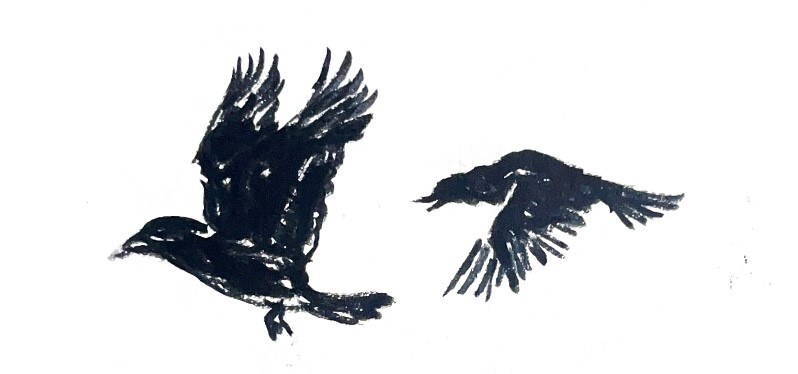
**I have sketched crows enough that they are a rare example of a subject matter that does not require me to have a reference (live or photo) to get a general likeness. Today’s sketches presented above were done quickly with a brush pen, during the last stretch of my train ride home last Friday. I *think* they present a likeness to crows, but you can be the judge of that.
***a congregation or gathering of crows is aptly called a murder of crows
© Christopher M Buddle 2022
-
Mr Fox
Abrupt stop, mid-stride
– smiling under orange fur.
Fantastic.
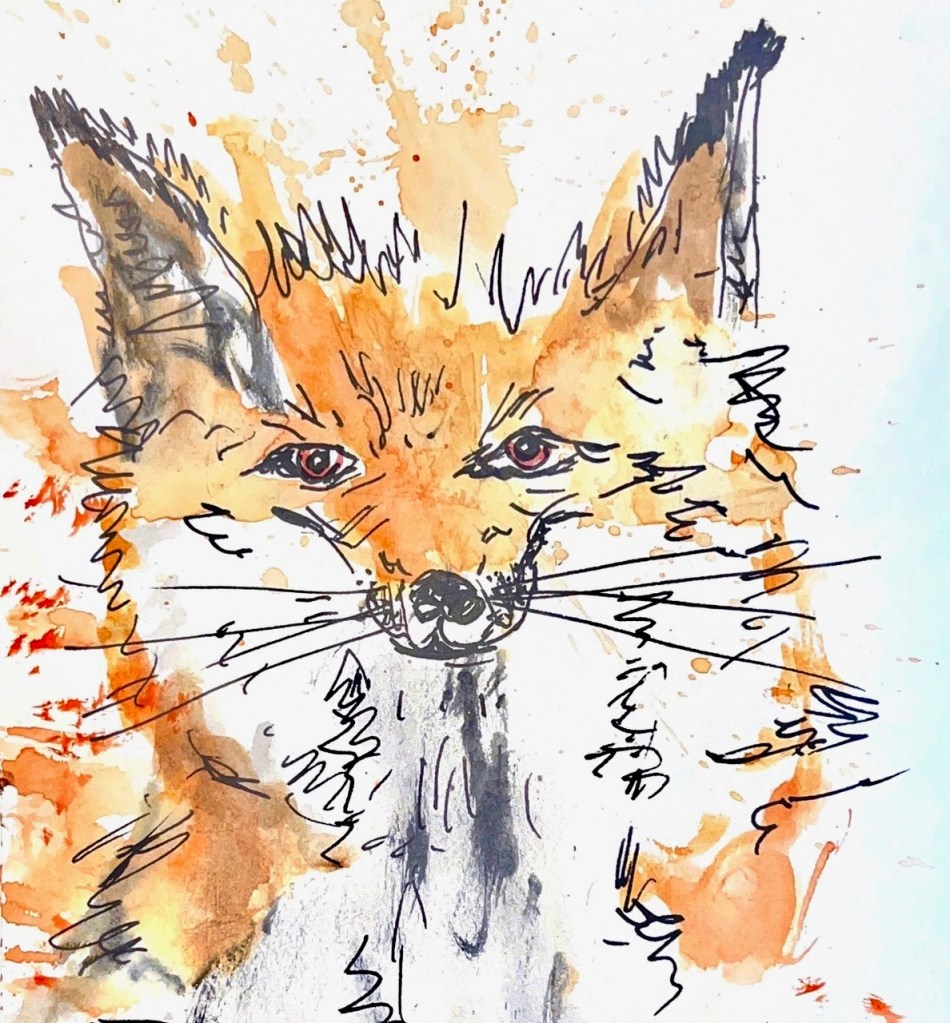
Notes: Foxes are marvelous mammals. Dashing, quick, and with fabulous colouration. I am a huge fan of Wes Anderson movies so when I think of foxes I often reflect on the stop-motion depiction of Fantastic Mr Fox. Mr. Fox is clever, and creative, and often (too?) bold, just like the movie. Foxes are pretty great at outwitting humans (with our relatively stunted senses) and while they are not always a friend to farmers, I hold a lot of admiration for them. And, like rabbits, they are often found in our towns and cities, and when rabbits and foxes are around together, you can be sure the chase is on...
-
Terminal B
Cellphones and rollerbags
The dreariness of airports
Time is fast and slow.
Staring at smartphones.
Vacant looks in sterile lounges.
The joy of travel.
Sparrow flies to the high ceiling
– at Terminal B
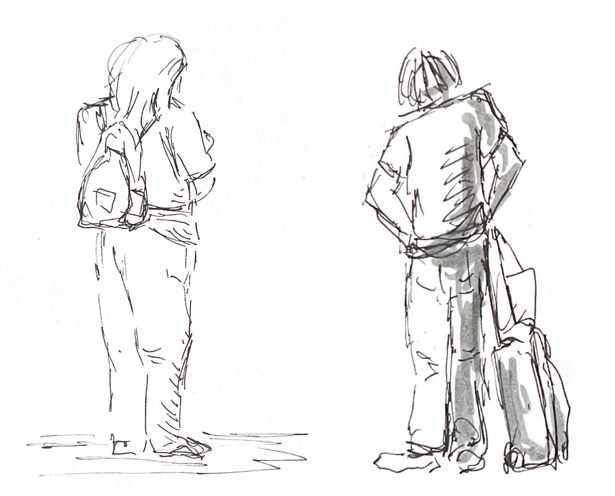
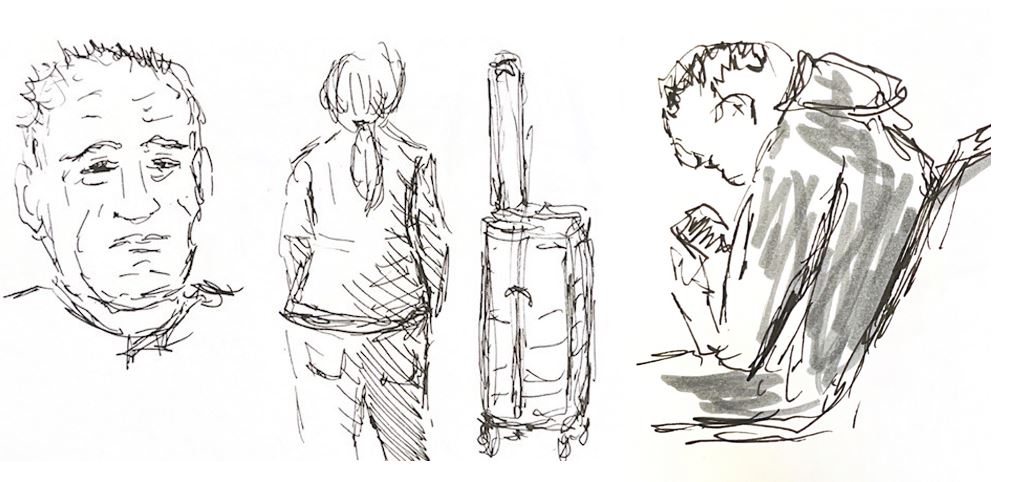
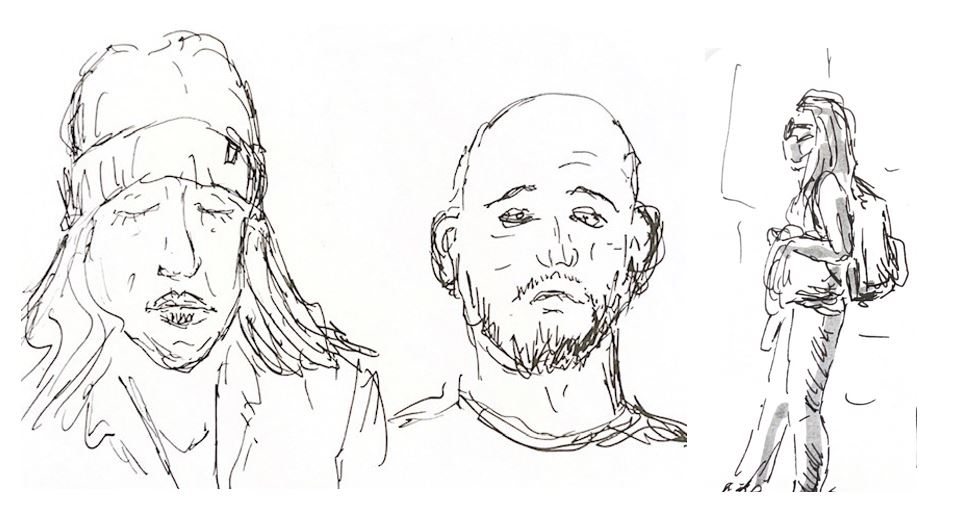
Notes: Airports are strange places*. I was travelling earlier this month so I got to experience quite a few of them. And, of course, airports always seem to involve either rushing around in a panic, or boredom – there is not much in between. For someone who likes certainty (don’t we all?), I find that airports can sometimes be anxiety-provoking. I generally try to practice my figure and portrait sketches** when waiting in an airport lounge, and the images I am sharing today were done earlier in November at airports in Orlando, Newark, and Raleigh, and I also had time for writing more than a few Haiku***. I seem to be unable to focus on much when in transit, so getting out the pen and sketchbook is somewhat therapeutic and helps pass the time. People watching is, I think, a fun part of the airport experience, and I certainly observed the ongoing attachment to fast food, cellphones and music-listening. While a few people had books (or e-books), most were scrolling through their screens, texting, or otherwise fixated on the small screen they were clutching, or enjoying French Fries. Or, they were sitting with their eyes closed, listening to music (or, of course, there were some families present too, and their level of activity was markedly different, and was more about parents trying to ‘shush’ their kids, or chase after them. It was hard to do figure sketches with all that activity!). Overall people were in their own bubbles, so despite airports being such busy places, they can be surprisingly quiet.
* They are strange because of people, long lines, lots of emotion, security, exaggerated food prices, weird kiosks (how many phone cases do people need?), ‘massage’ chairs, but also because sometimes you see nature in airports too – sparrows and other wildlife can sometimes moves about the cavernous spaces. The strangeness of airports, I think, is so well captured in Station Eleven. A book I highly recommend.
**full disclosure: I really struggle with drawing people or any parts of them. For some reason I can’t seem to find the enthusiasm to practice the human figure or face, but like all things, practice is the key. I try to keep the tools very simple when doing quick figure sketches i.e., technical pen and sometimes a grey brush pen for a bit of shading, and a small (3 x 5”) pocket sketchbook. I also try to be really discrete and quick about the sketches. I try to sit relatively far from subjects, and each sketch is typically done in just 2-3 minutes. More time does not tend to help, I find!
** this is very full post compared to usual. I was struggling with what to publish (for both the quick sketches and the Haiku), so I just published a bunch of things. Hope you don’t mind! Maybe this will inspire you to grab a sketchbook and pen next time you are travelling? It’s a low investment way to make your boring time in airports perhaps a bit more interesting.
© Christopher M Buddle 2022
-
Cardinal
November snowfall
Red alert! (in the backyard)
– feathered perfection.
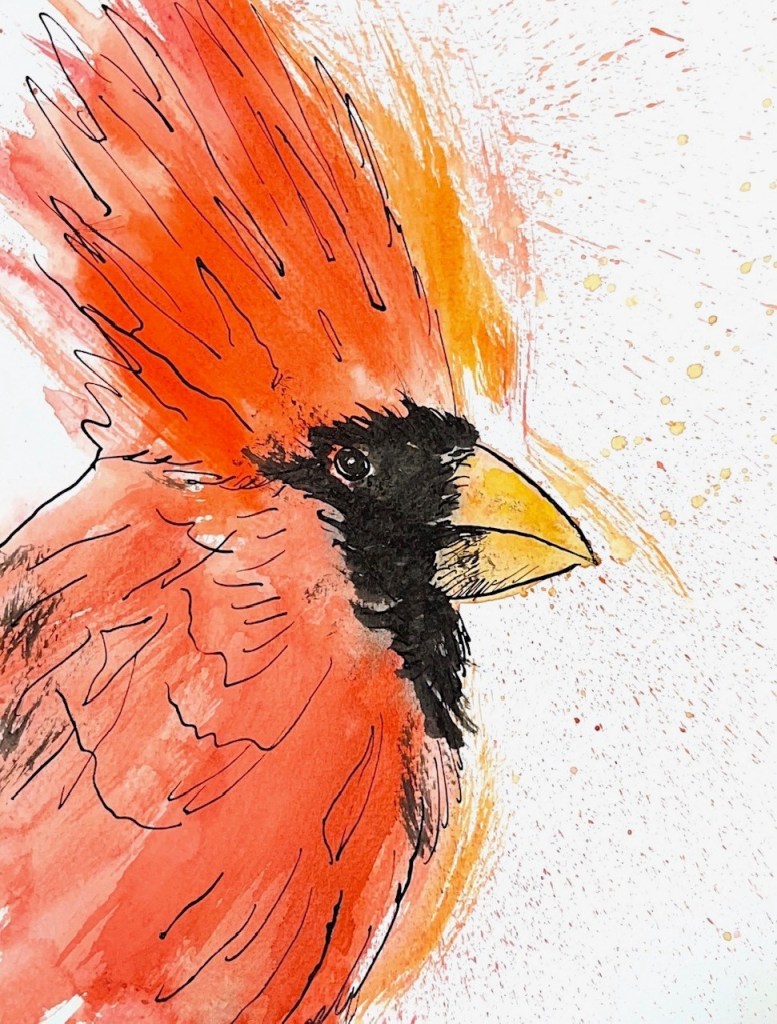
Notes: I am so grateful that we have many northern cardinals* that inhabit our backyard year-round, and after a snowfall (the first of which we had last week), their brilliant red plumage stands out perfectly against the white backdrop. The contrast is so incredible. They are really quite interesting birds, and I am forever astounded by the volume that the males have when they sit atop a tree singing their hearts out – their vocalizations seem to carry across many, many blocks (you can find examples of their vocalizations here). Sometimes (early in the morning, in the spring) it seems as if they are sitting right outside the bedroom window, blasting straight into our brains at sunrise. They can be kind of piggy at the bird feeders, but I just don’t mind since I think they are so beautiful and my world is better because northern cardinals are part of it.
* my sloppy/messy watercolour is low on accuracy, but if I close my eyes, I imagine cardinals more like my depiction, above. Lots of wild colour kind of all over the place.
© Christopher M Buddle 2022
art, cardinal, drawing, ink, nature, northern cardinal, ornithology, pen, poetry, snow, Watercolor, Watercolour, winter -
Cottontail
Twitch, watch, smell, listen
Tasty grass; foxes are near.
Hop-dash, and survive.

Notes: Cottontail rabbits are so very cute, and I am fortunate to see them often in our yard, sampling some clover or other grass, but always near to some kind of protection. We have a cedar hedge between our house and the neighbours, and I sense that the wee rabbits always have one eye on the hedge, ready to zig-zag and bounce quickly under its cover. They are hyper-aware, using their excellent sense of hearing, smell, and sight. Life as a rabbit is likely very stressful as so many predators are lurking about, waiting to grab a meal. I read “Watership Down” when I was very young, and it left such a deep impression on me and I am reminded of that story every time I see a rabbit: I think of Hazel, Fiver, and Bigwig and their adventures. I read it again recently, and the story is still very good, and I was impressed at how much biology and natural history and conservation science is embedded in the novel. And, the novel does very accurately paint a picture of the difficult life of a rabbit.
© Christopher M Buddle 2022
-
Shipping
Shipping containers travel the world.
– seeing other shipping containers.
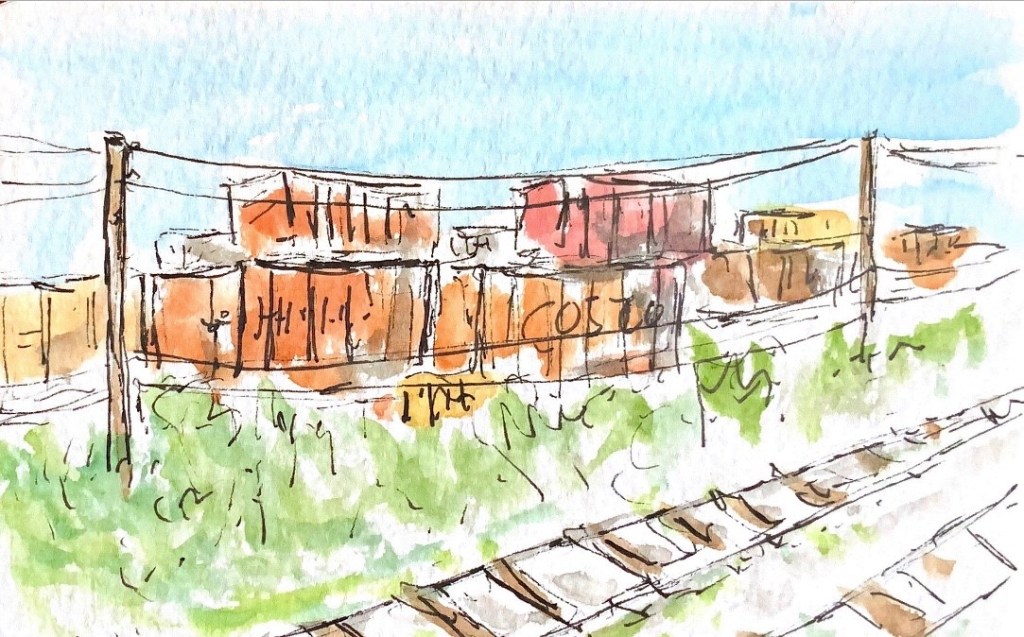
Notes: My commuter train takes me past stacked up shipping containers and this causes me to reflect on their travels*. For example, moving across the vast Pacific on a giant ship, perhaps through the Panama canal, up to the Port of Montreal, and perhaps on a train across the great plains. The logistics behind all of this are mind-boggling, and fascinating**. But then I realize that the life of a shipping container is likely rather ‘constricted’ since these boxes are packed so tightly on the ship or train. The travels of the shipping containers are not very glamorous. Regardless, they are a reminder, to me, that we are a connected world.
*yes, this blog is normally nature-inspired, but it’s not necessary to be constrained by that framing! So, today you get train tracks, hydro lines, and shipping containers. And, you will note that the Haiku doesn’t look too Haiku-like, but that’s ok 🙂
** you can spend a lot of time digging into facts about shipping containers. For example… this post says that 95% of cargo, worldwide, is shipped via shipping containers. Wow.
© Christopher M Buddle 2022
 Nature's Reverie