
beach treasures
are reminders
of the miracle of existence
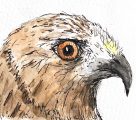
Several months ago, I received Maria Popova’s publication An Almanac of Birds: 100 Divinations for Uncertain Days. It is stunning. A few times each week, I tuck several of her cards into my backpack and read them on the train—small anchors of reflection amid motion.
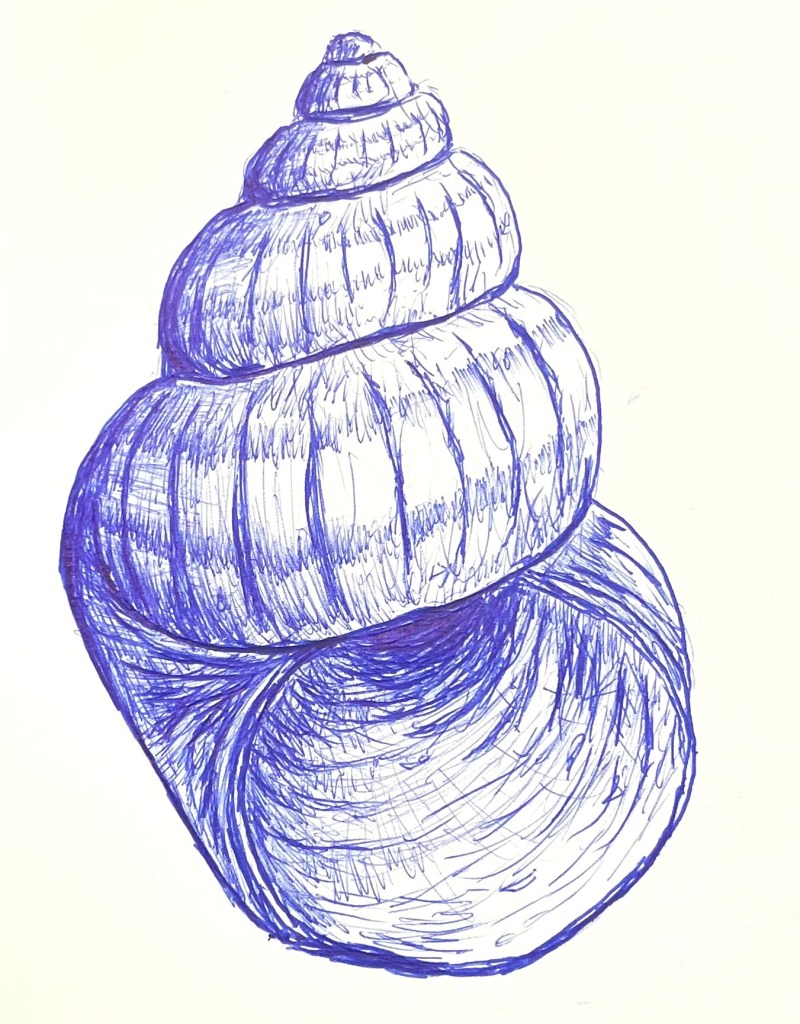
Earlier this week, one card offered a line that lodged itself firmly in my mind: “Never forget you are a breathing accident of chance.” It stayed with me longer than most words do. Around the same time—perhaps not coincidentally—I found myself making ballpoint drawings of sea shells (see above!).
There is something deeply satisfying about finding shells while beachcombing. Part of it is their quiet beauty: spirals refined by repetition, surfaces worn smooth by time and tide. But for me, the deeper pull is this—when you hold a shell, you are holding the remnants of a past life. A life that existed because of a long and astonishing cascade of contingent events.
This life—and the countless species that share the planet with us—are not inevitabilities. Nor are they purely random or haphazard. They are, instead, dizzying in their improbability. For natural selection to act, there must be variation: the right mutation, arising at the right time, under the right conditions. The proper mix of amino acids, nutrients, energy, pressure, temperature. A chain both resilient and fragile, stretching across deep time. It feels almost miraculous that it was never broken.
How did sea creatures—squid and sharks, sand dollars and periwinkle shells—emerge from improbability into existence? And how did we? The rational scientist in me readily attributes this to evolution and the steady, unsentimental power of natural selection. But at the same time, there remains room for wonder, awe, even the mystical or spiritual. These perspectives are not in conflict. I find them mutually enriching.
I am deeply grateful for Maria Popova’s gift of reminding us of our impermanence—of our fleeting tenure on this planet—and for reminding us how extraordinary it is that we get to share this world, briefly, with so many other forms of life.
The next time you see a sea shell resting on a mantle or shelf, consider that it is far more than a souvenir of a past trip to the ocean. It is a quiet testament to improbability. A small, durable echo of life that once breathed, endured, and vanished.
Much like us.
© Christopher M Buddle 2026
 Nature's Reverie